By Federal City News Staff
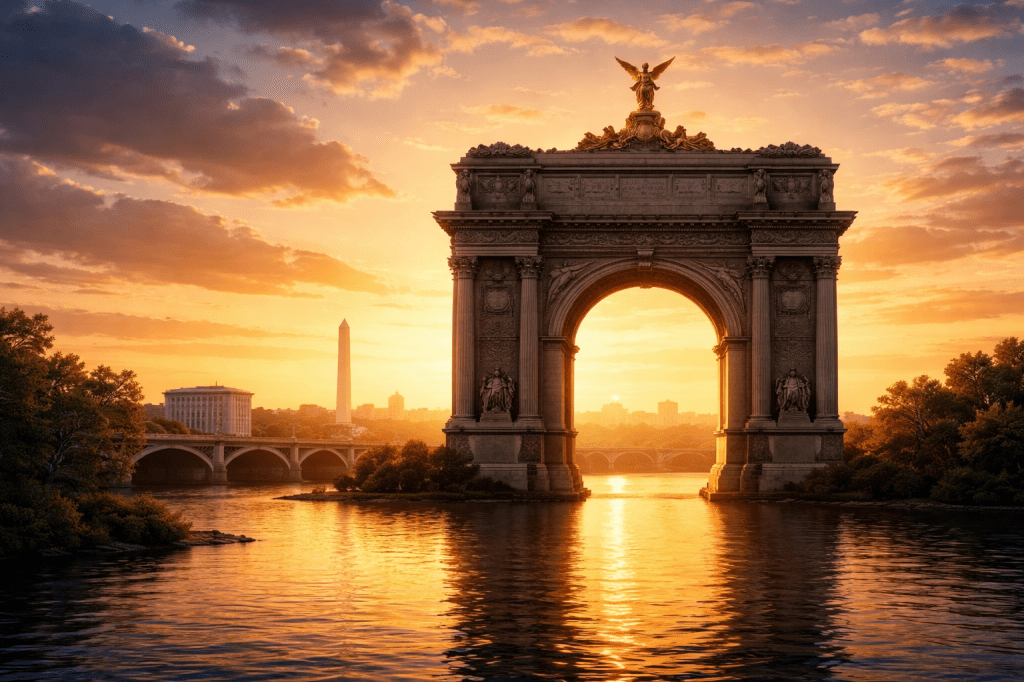
Washington politics rarely misses an opportunity to turn symbolism into a full-blown legal war. The latest example comes as a coalition of Democratic lawmakers and activists has launched legal action against the Trump administration over a proposal to construct a large ceremonial arch in the nation’s capital — what critics have dubbed a “triumphal arch.”
The lawsuit, first reported by The Washington Post, argues the project would violate federal planning processes and potentially disrupt historic preservation rules governing the capital’s monuments and public spaces. Opponents claim the proposed structure, envisioned as a classical arch honoring American achievements, would politicize the National Mall and represent an attempt by President Donald Trump to leave a controversial architectural legacy in the city.
But supporters of the project say the legal challenge is just the latest chapter in a now-familiar pattern: Democrats turning to the courts to block nearly every policy initiative of the Trump administration.
A Monument Proposal Becomes a Political Battlefield
According to reporting on the proposal, the concept centers on constructing a monumental arch somewhere within Washington’s ceremonial core — an idea inspired by historic arches found in cities like Paris, Rome, and Berlin.
Backers argue that such monuments have long been used by nations to commemorate victories, honor national unity, or celebrate major historical milestones. They point to famous examples like the Arc de Triomphe in France and the Arch of Constantine in Italy.
In Washington, however, nearly every new monument proposal becomes a bureaucratic gauntlet involving the National Capital Planning Commission, the Commission of Fine Arts, and the National Park Service, which oversees much of the National Mall.
Democratic lawmakers and allied advocacy groups argue the proposal bypasses or pressures those planning processes.
But critics of the lawsuit argue the reaction reveals something deeper: Washington’s entrenched resistance to anything associated with Trump.
The Lawsuit Strategy Returns
The arch dispute follows a pattern that has become increasingly common in modern American politics — policy disagreements immediately escalating into legal battles.
Since the start of Trump’s second term, Democratic attorneys general and allied organizations have filed numerous lawsuits challenging federal immigration policies, regulatory changes, and executive actions. The strategy mirrors tactics Republicans used during the Biden administration, when conservative states frequently sued over environmental rules, student loan programs, and immigration policy.
Still, critics say the current wave of litigation has reached a new level of predictability.
If the Trump administration proposes something major — whether a border enforcement initiative, regulatory rollback, or now even a monument proposal — a lawsuit often follows within days.
Supporters of the arch project say that trend is turning policy debates into courtroom showdowns rather than democratic discussions.
A Symbolic Fight Over the Capital’s Identity
The deeper issue may not be the arch itself, but what it represents.
Washington’s monumental core is designed to embody national ideals rather than partisan figures. Major monuments such as the Lincoln Memorial, Washington Monument, and World War II Memorial commemorate presidents, wars, or national achievements broadly recognized across political lines.
Opponents argue a triumphal arch proposed under Trump risks transforming the Mall into a stage for personal legacy-building.
Supporters counter that nearly every monument in the capital reflects political decisions of its era — and that the current resistance reveals a deeper unwillingness among Washington’s political class to accept that the country elected Trump again.
The Monument Politics of Washington
Washington has never been free of monument controversies.
Even widely respected memorials faced years of political fighting before approval. The Vietnam Veterans Memorial sparked intense debates over its design in the 1980s. More recently, proposals for monuments related to Dwight Eisenhower, Martin Luther King Jr., and World War I generated similar disputes over location, symbolism, and cost.
The arch proposal appears poised to follow the same contentious path — except this time the controversy is unfolding in a hyper-polarized political environment.
Instead of debating design details or historical context, the fight has quickly become a broader ideological conflict over Trump’s presidency.
Lawsuits as the New Political Language
The legal battle also highlights how Washington’s political conflicts increasingly move from Congress to the courts.
Rather than negotiating policy changes or seeking legislative compromises, political factions often attempt to halt initiatives entirely through litigation.
Supporters of the arch argue that trend undermines the basic function of elections.
“If every initiative is immediately tied up in court,” one supporter told reporters, “the executive branch effectively loses the ability to govern.”
Critics respond that lawsuits remain one of the few tools available when they believe federal law or planning rules are being ignored.
But even some legal scholars warn that the constant cycle of lawsuits risks turning the judiciary into the primary battlefield of American politics.
What Happens Next
The lawsuit will likely force federal courts to determine whether the administration followed the proper planning process before advancing the arch proposal.
If the court sides with the challengers, the project could be delayed indefinitely or halted entirely.
If the administration prevails, the proposal would still face additional design reviews and approvals from federal planning agencies.
Either way, the arch debate appears certain to become another flashpoint in the broader political struggle defining Washington in the Trump era.
A City Defined by Conflict
In many ways, the controversy reflects Washington’s deeper transformation over the past decade.
The capital was once designed to symbolize national unity through its architecture and monuments.
Today, even the idea of building a monument can trigger lawsuits, partisan outrage, and national political warfare.
Whether the proposed arch is ever built may ultimately matter less than what the fight reveals: in modern Washington, almost nothing escapes the gravitational pull of partisan conflict.
For better or worse, the nation’s capital has become a place where every symbol — even a stone arch — carries the weight of America’s political divide.
 Federal City News