
By FCN Staff
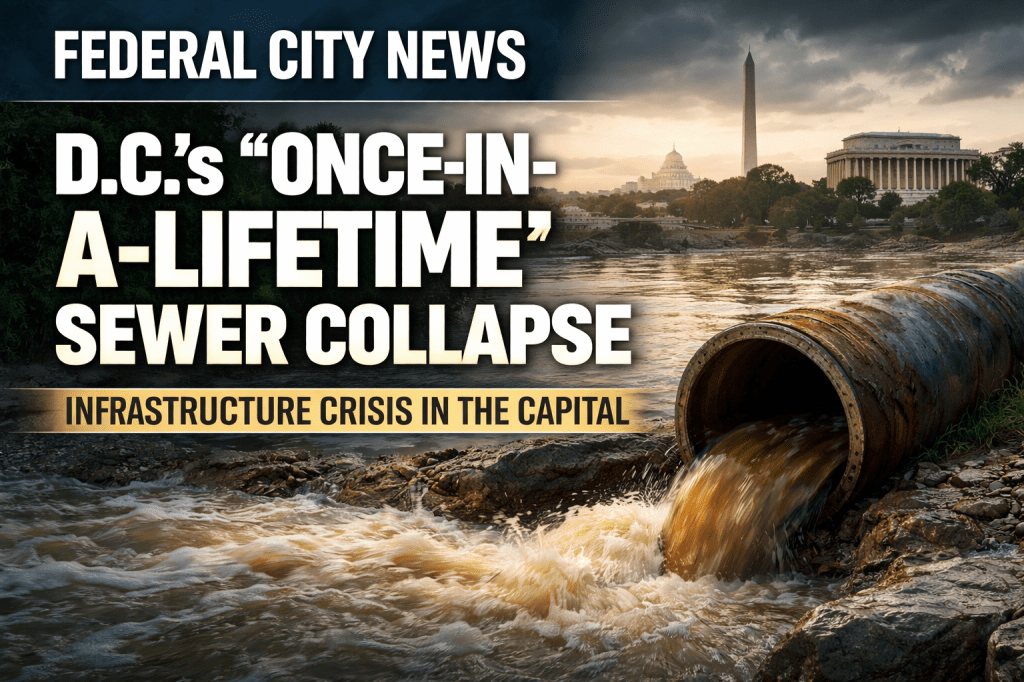
Washington, D.C. officials say the catastrophic collapse of a major sewer pipeline that dumped hundreds of millions of gallons of raw sewage into the Potomac River was essentially unpredictable — a “once-in-a-lifetime type break.” But for many residents and watchdog groups, that explanation is unlikely to quiet growing concerns about aging infrastructure, environmental risk, and whether government agencies are doing enough to prevent the next crisis.
In January, a section of the Potomac Interceptor, a massive 72-inch sewer pipeline carrying wastewater from Northern Virginia and parts of Maryland to the District’s Blue Plains treatment plant, suddenly collapsed near the Clara Barton Parkway in Montgomery County. The failure released more than 200 million gallons of untreated sewage into the Potomac River before crews could fully divert the flow.
The spill is now considered one of the largest sewage releases in U.S. history, raising serious environmental and public health concerns in the nation’s capital region.
“No Warning Signs,” Officials Say
According to D.C. Water CEO David Gadis, internal inspections conducted before the collapse showed no indication that the pipeline segment was in imminent danger of failing.
After reviewing inspection videos and engineering reports, Gadis said the utility’s assessments of the pipe’s condition appeared accurate and that there was no reason to move the section ahead of its scheduled repair timeline.
The pipe was already slated for rehabilitation this year as part of ongoing maintenance work.
But that explanation raises an uncomfortable question: if one of the region’s largest wastewater pipelines can fail catastrophically without warning, how confident should residents be in the broader system?
A 60-Year-Old System Under Stress
The Potomac Interceptor is part of a sprawling wastewater network that dates back decades. The pipe that failed was built in the 1960s and carries wastewater from multiple jurisdictions across the Washington region every day.
At peak flow, the system can move tens of millions of gallons of sewage daily toward the Blue Plains Advanced Wastewater Treatment Plant in Southwest Washington.
Infrastructure experts say aging sewer lines across the United States are under increasing pressure from population growth, development, and deferred maintenance.
And troublingly, the section that collapsed may not be the only weak point in the system.
Recent assessments have reportedly identified two additional segments of the interceptor pipeline that are rated as high risk or worse than the section that failed.
For residents and environmental advocates, that revelation suggests the January collapse may not have been as isolated an event as officials would like to believe.
Environmental Impact Still Being Measured
The spill triggered immediate warnings from health and environmental officials urging residents to avoid contact with water near the contamination zone.
Testing found extremely high levels of bacteria near the spill site — at one point E. coli concentrations measured thousands of times above federal safety standards.
Although drinking water supplies were not affected, the spill raised concerns about damage to fish, wildlife, and aquatic ecosystems in the Potomac River.
Environmental groups have also raised questions about transparency and communication during the early days of the incident.
Infrastructure Spending vs. Infrastructure Reality
The District has spent billions of dollars over the past decade on water infrastructure projects, including the massive Clean Rivers Project designed to reduce sewage overflows into local waterways.
Yet the Potomac Interceptor collapse highlights the uncomfortable reality that America’s infrastructure problems extend well beyond flashy mega-projects.
Large systems depend on thousands of aging pipes, tunnels, and pumping stations — many of which are buried underground and largely out of sight until something goes wrong.
Across the country, the Environmental Protection Agency estimates hundreds of billions of dollars in wastewater infrastructure upgrades will be needed in coming decades.
Accountability in the Capital Region
For a region that prides itself on being the center of federal power and regulation, the sewage disaster in the Potomac raises an ironic question: if Washington cannot keep its own wastewater infrastructure from failing catastrophically, what does that say about the state of infrastructure nationwide?
D.C. Water insists the collapse was an unpredictable anomaly — a freak failure in an otherwise well-maintained system.
But with additional sections of the pipeline already flagged as high risk, residents and lawmakers may soon demand a deeper review.
Because in the nation’s capital, a “once-in-a-lifetime” infrastructure failure has a way of becoming tomorrow’s congressional hearing.
 Federal City News