By FCN Staff
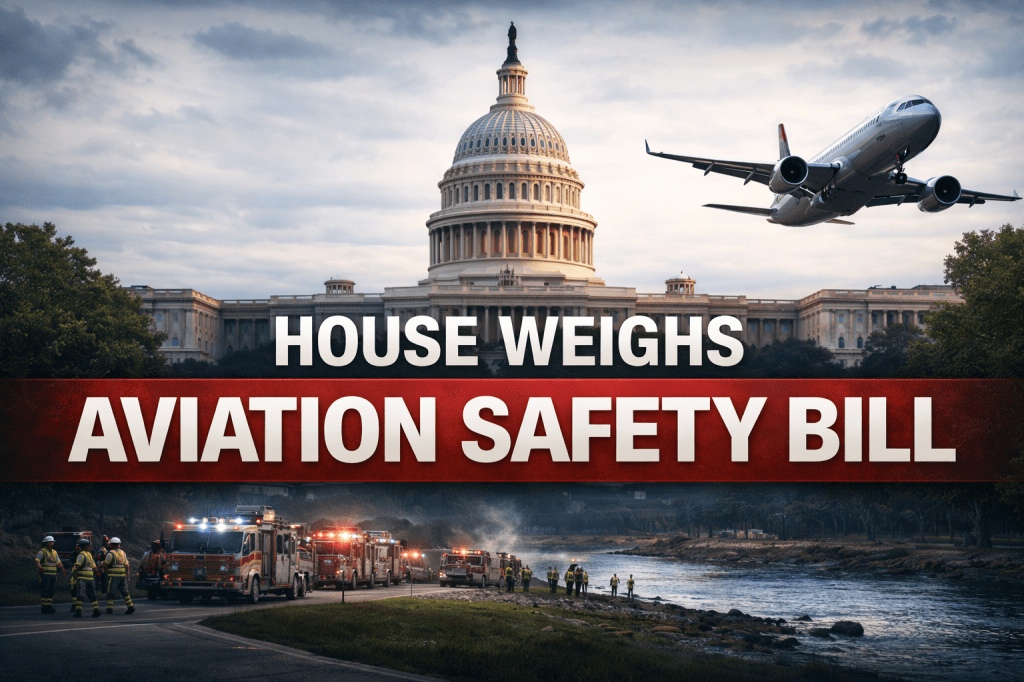
WASHINGTON, D.C. — Lawmakers on Capitol Hill are advancing new aviation safety legislation following the deadly midair collision over the nation’s capital — a tragedy that has reignited debate over air traffic oversight, regulatory gaps, and whether Washington has been too slow to modernize critical infrastructure.
Members of the United States House of Representatives are now considering a bill that supporters argue could have prevented the fatal crash near Ronald Reagan Washington National Airport earlier this year. The collision, which occurred over the Potomac River, shocked the region and prompted renewed scrutiny of congested airspace in one of the busiest and most complex aviation corridors in the country.
What the Bill Would Do
According to reporting, the proposed legislation would strengthen air traffic coordination requirements, accelerate technology upgrades, and mandate enhanced data-sharing between civilian and military aviation operators in high-density airspace. It also seeks to impose stricter oversight on near-miss reporting and improve early-warning systems designed to prevent in-air conflicts.
Supporters say the reforms are long overdue.
For years, aviation watchdogs and pilots have warned that the airspace around Washington, D.C. — layered with commercial, private, military, and restricted zones — operates under immense pressure. Critics argue that while technology has advanced, regulatory structures have not kept pace.
The bill would require the Federal Aviation Administration (FAA) to modernize certain traffic management systems and conduct more frequent safety audits in high-risk metropolitan corridors.
A Preventable Tragedy?
Some lawmakers contend that earlier passage of similar reforms might have reduced the likelihood of the crash. Investigators have pointed to a “chain of errors,” including communication gaps and situational awareness failures, that led to the fatal incident.
While the official investigation remains ongoing, the political debate is already underway.
Several House members argue that bureaucratic delays and incremental reforms have allowed systemic weaknesses to linger. They say Congress has been slow to push the FAA toward more aggressive modernization timelines — particularly in high-volume airspace like Washington.
Others caution against politicizing a tragedy before investigators complete their work. They argue that aviation remains statistically one of the safest modes of transportation in the country and warn against reactive policymaking.
Oversight, Accountability, and Federal Responsibility
The debate also raises broader questions about federal responsibility. Air traffic control is a federal function. When breakdowns occur, they are not local missteps — they are national failures.
For a city that serves as both a global capital and a transportation hub, the stakes are unusually high. Reagan National’s proximity to downtown, the Pentagon, and restricted federal airspace creates operational complexity unmatched in most other U.S. cities.
Center-right lawmakers framing the debate emphasize a simple principle: if Washington demands regulatory compliance from airlines, airports, and private operators, then federal agencies must meet the same standard of urgency and modernization.
The bill’s sponsors argue that targeted reform — not sweeping bureaucracy — is the answer. Their approach focuses on specific technological upgrades, improved transparency, and clearer lines of accountability.
Political Crosscurrents
The aviation bill arrives amid broader debates over infrastructure spending, federal oversight, and regulatory efficiency. Some fiscal conservatives are scrutinizing the proposal’s cost structure, while reform-minded members insist that failing to invest in modernization now could prove far more expensive — in both dollars and lives — later.
In a divided Congress, aviation safety may offer one of the few areas where bipartisan agreement is possible. After all, the airspace above Washington belongs to everyone — lawmakers, military personnel, federal workers, tourists, and residents alike.
The Bigger Picture
The midair collision has become more than a tragic headline. It has exposed vulnerabilities in a system many Americans assume functions flawlessly.
If Congress acts decisively, the tragedy may serve as a catalyst for long-delayed modernization. If not, critics warn, Washington risks proving once again that it can investigate failures more effectively than it prevents them.
For a city that governs the skies, that would be an unacceptable outcome.
 Federal City News