By Federal City News Staff
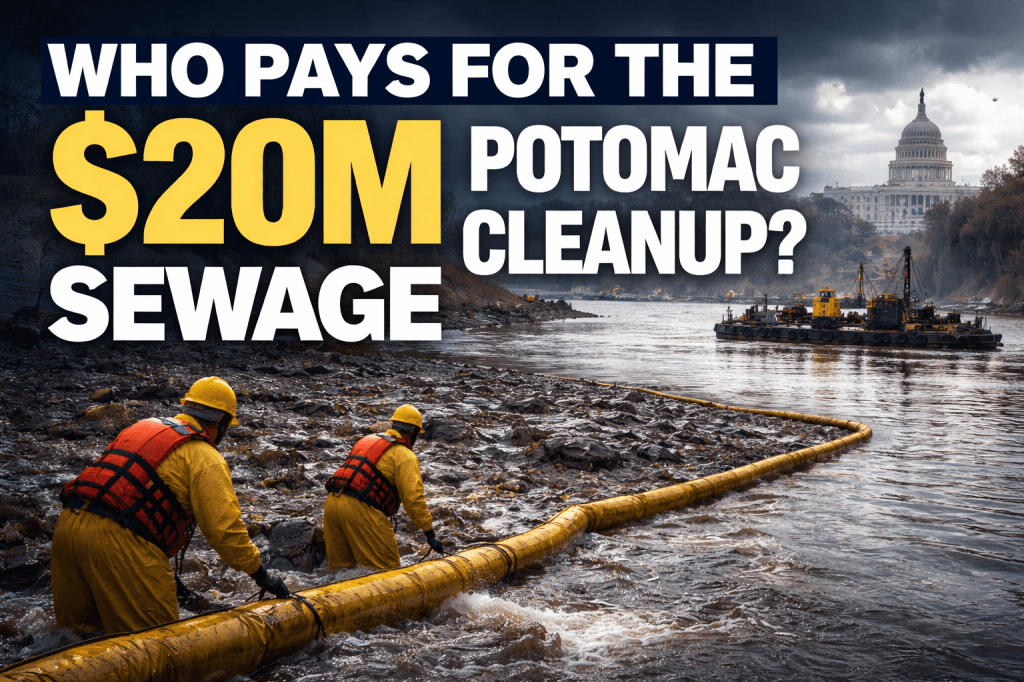
The price tag for the Potomac River sewage cleanup and emergency repairs is climbing past $20 million — and the biggest question facing Washington right now is simple: Who pays?
According to reporting from WTOP, the costs associated with containing the massive sewage release, repairing damaged infrastructure, deploying emergency bypass systems, and restoring affected waterways are already substantial. More expenses are expected as long-term remediation and monitoring continue.
But while officials debate jurisdiction and responsibility, D.C. residents are left wondering whether they’re about to get handed the bill.
A Regional Failure, Not Just a D.C. Problem
The Potomac Interceptor failure was not confined neatly within District lines. The river flows through Maryland, Virginia, and the District. Wastewater infrastructure is interconnected. Environmental consequences ripple outward.
Yet early signals suggest that cost recovery could become a bureaucratic tug-of-war between local utilities, state agencies, insurers, and potentially federal partners.
The District’s primary water utility, DC Water, has already mobilized crews and emergency systems to mitigate damage. Meanwhile, state leaders in Maryland and Virginia are under pressure to demonstrate accountability and share financial responsibility where appropriate.
The public deserves clarity:
- Was the failure due to deferred maintenance?
- Was it structural fatigue?
- Was there a preventable engineering oversight?
- Who had inspection authority?
Until those answers are fully documented, taxpayers remain exposed.
The Hidden Cost of Infrastructure Neglect
This incident underscores a broader reality: aging water and sewer infrastructure across the DMV region is reaching its limits.
For years, officials have prioritized splashy ribbon cuttings and federal grant announcements. Meanwhile, underground pipes — the unglamorous backbone of modern cities — continue to deteriorate.
When infrastructure fails, it’s not just an environmental problem. It becomes:
- A public health risk
- A tourism liability
- A property value concern
- A fiscal burden
And ultimately, it becomes political.
Federal Aid — or Federal Silence?
With environmental damage affecting a major national waterway adjacent to federal land and monuments, there is a legitimate argument for federal involvement. The Potomac River is not merely local infrastructure — it’s part of the nation’s capital.
Will Congress step in?
Will FEMA or EPA emergency funds be deployed?
Or will D.C. ratepayers see their utility bills quietly rise?
Those questions remain unanswered.
Ratepayers vs. Accountability
If costs are passed through to customers, residents could face higher water and sewer rates in the coming budget cycles.
At a time when inflation continues to strain working families and housing affordability remains a crisis in the District, adding infrastructure surcharges without transparency would be a mistake.
D.C. leaders must commit to:
- Full public disclosure of repair costs
- A breakdown of liability and shared responsibility
- An independent engineering review
- Clear communication before any rate increases
Anything less invites distrust.
A Wake-Up Call
The Potomac sewage crisis is a reminder that infrastructure is not partisan — but accountability is.
Residents have a right to clean water, functional systems, and honest answers. Whether the bill lands on D.C., Maryland, insurers, or federal agencies, one thing is clear:
Taxpayers should not be the default fallback when oversight fails.
The cleanup may cost $20 million today. The real cost will depend on whether leaders treat this as a one-off emergency — or a serious reckoning with the region’s aging infrastructure.
 Federal City News