
By Federal City News Staff
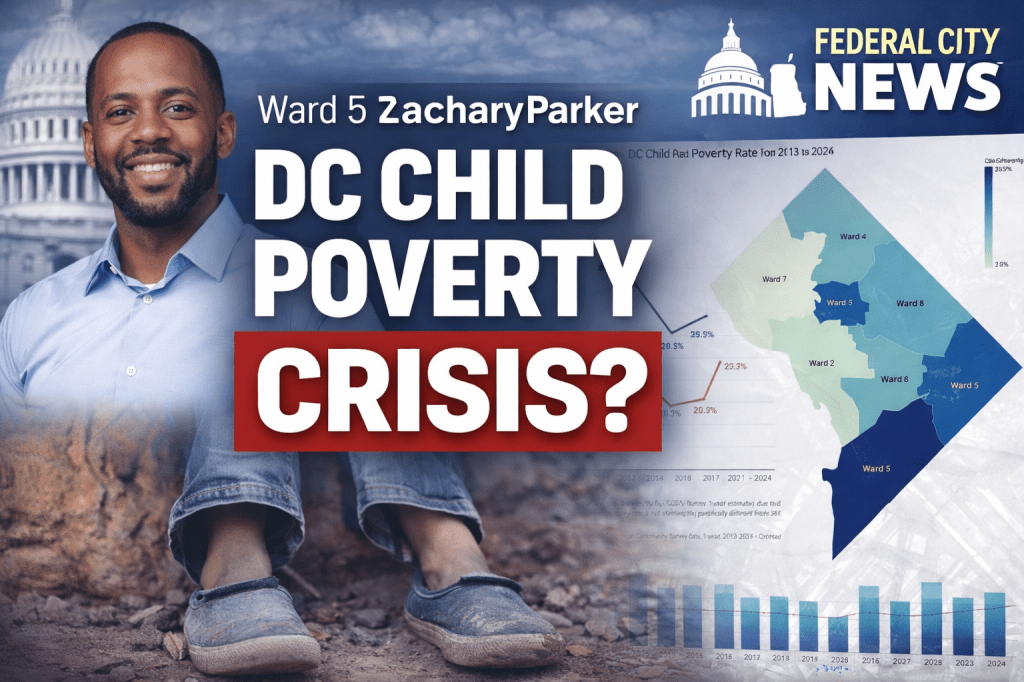
Ward 5 Councilmember Zachary Parker is pointing to a new report from the D.C. Fiscal Policy Institute (DCFPI) warning that child poverty in the District has returned to “extreme levels” after a brief decline during the pandemic years.
The report attributes the earlier drop largely to expanded federal benefits, particularly the temporary expansion of the Child Tax Credit. Parker echoed that argument on social media, writing that the findings show “exactly why policies like the Child Tax Credit matter and why we must fight to ensure it lives on.”
But the report also raises a deeper question: after years of record local spending, rising taxes, and progressive policymaking in the District, why are so many children still struggling?
A Temporary Drop, Then a Reversal
According to DCFPI’s analysis of Census data, child poverty in D.C. fell sharply during 2021 and 2022 when federal stimulus payments and the expanded Child Tax Credit were in effect. Once those programs expired, poverty rates rose again.
The headline framing emphasizes the end of federal aid. However, critics argue that relying on temporary federal checks is not a long-term anti-poverty strategy — particularly in a city with one of the highest per-capita budgets in the nation.
Washington spends more per resident than nearly any state government. Yet disparities across wards remain stark, especially east of the river.
Ward Disparities Persist
The report highlights significant racial and geographic disparities in child poverty. Wards 7 and 8 continue to experience the highest poverty rates, while wealthier wards see far lower numbers.
That reality has existed for decades — under both Democratic administrations locally and Democratic leadership on the Council.
The question for Ward 5 and the rest of the city is not whether federal tax credits provide short-term relief — they clearly did — but why the District’s own economic development, education spending, and workforce initiatives have not produced durable upward mobility.
Dependency vs. Opportunity
Center-right policymakers argue that expanding refundable tax credits without structural reform risks creating cycles of dependency rather than opportunity.
While the temporary Child Tax Credit expansion reduced poverty rates on paper, it did not address underlying drivers such as:
- Persistent education achievement gaps
- High housing costs driven by restrictive zoning
- Public safety concerns impacting economic investment
- Workforce participation challenges
The District’s approach has often focused on redistribution rather than economic expansion in underserved neighborhoods.
What Should Ward 5 Be Asking?
Ward 5 sits at an economic crossroads. It contains industrial corridors, redevelopment zones, and working-class neighborhoods that could benefit from growth-focused policy — job creation, small business expansion, public safety improvements, and regulatory reform.
Instead of simply advocating for renewed federal checks, city leadership could:
- Incentivize business development east of North Capitol Street
- Streamline permitting and licensing for small entrepreneurs
- Expand vocational and apprenticeship pipelines tied to real employment
- Tackle public safety to attract private investment
Poverty cannot be solved by Washington sending itself money from Washington.
A National Conversation — But a Local Responsibility
The expiration of pandemic-era federal programs may have contributed to rising poverty numbers. But the District government controls its own tax structure, education system, housing policies, and economic strategy.
If child poverty has returned to “extreme levels,” that is not just a federal story — it is a local leadership story.
Ward 5 voters deserve more than press statements pointing to Congress. They deserve measurable progress that lasts longer than a temporary federal program.
The DCFPI report should spark debate — not simply about reviving the Child Tax Credit — but about whether the District’s governing philosophy is producing real upward mobility for families.
Federal City News will continue covering Ward 5 leadership and the broader debate over economic policy in the District.
 Federal City News