By FCN Staff
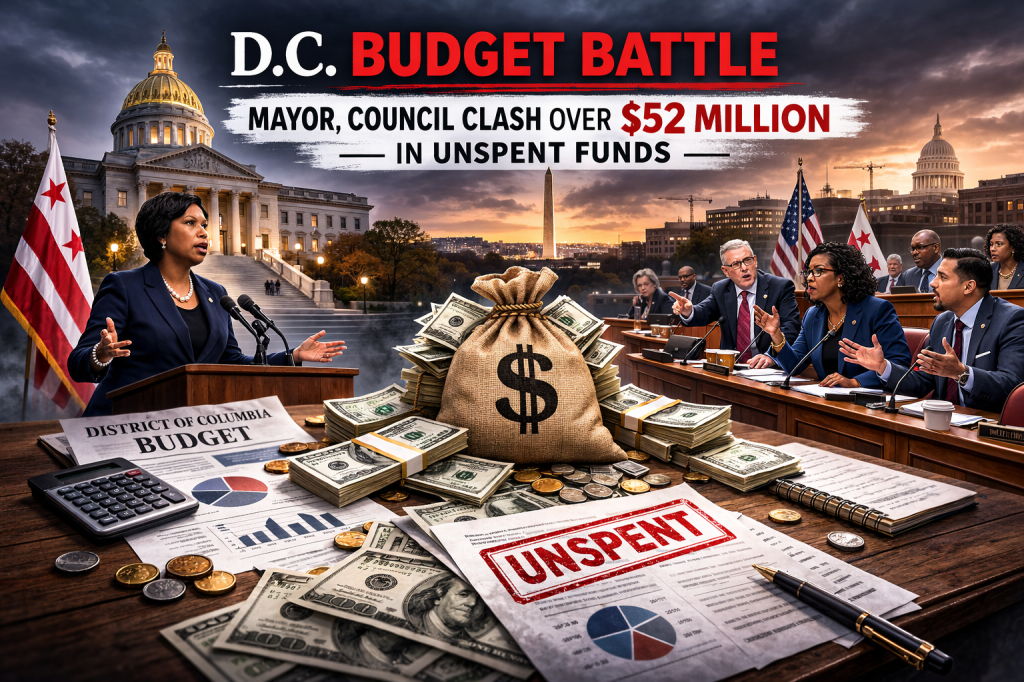
A new budget fight is brewing inside the Council of the District of Columbia, as members spar with Muriel Bowser over how to handle $52 million in unspent funds sitting in the District’s accounts.
At issue is whether the money should be redirected by the D.C. Council toward new or expanded programs—or remain under mayoral control as the District braces for continued fiscal uncertainty tied to federal actions and broader economic pressures.
The Dispute
According to WAMU reporting, the funds in question stem from previously appropriated dollars that were not fully spent. Some Council members argue that with residents still facing high housing costs, public safety concerns, and strained city services, it makes little sense to leave tens of millions idle.
Mayor Bowser’s team, however, has signaled caution. The administration argues that the District remains vulnerable to outside fiscal shocks—particularly from Congress—and should avoid rushing to spend money that may be needed to stabilize the budget later this year.
This is not a small disagreement. It reflects a deeper divide over fiscal philosophy inside the Wilson Building: spend now to address pressing needs, or hold reserves to guard against future disruption.
A Pattern of Fiscal Instability
The dispute comes on the heels of repeated clashes between D.C. and Congress over the District’s autonomy and budget authority. Congress has already intervened in local fiscal matters in recent months, and uncertainty around federal tax and spending policy continues to ripple through the District’s long-term projections.
In that environment, Bowser’s fiscal restraint argument has some merit. The District does not have the same sovereign flexibility as a state. When Congress steps in, local leaders are left scrambling.
But Council members counter that unspent money is not a rainy-day fund unless formally designated as one. If dollars were allocated for specific purposes and not used, the legislative branch has the authority—and arguably the responsibility—to reassess those priorities.
Governance vs. Politics
At its core, this debate is about governance. Should the executive branch maintain greater control over contingency funds during uncertain times? Or should the legislative branch reassert its spending authority and push money toward visible community priorities?
Critics of the administration note that the District’s fiscal management has already been under pressure. Rising costs, uneven service delivery, and ongoing infrastructure challenges have left some residents skeptical of City Hall’s stewardship.
Supporters of the mayor argue that fiscal discipline is precisely what keeps D.C. competitive and financially stable—especially when federal politics remain unpredictable.
What Happens Next?
The Council could move to reallocate the $52 million through legislative action, setting up a potential veto fight or compromise negotiation with the mayor’s office.
In the broader context, this skirmish underscores the structural tension built into D.C.’s hybrid system of local governance under congressional oversight. When autonomy is conditional, fiscal prudence carries extra weight.
But so does transparency.
If funds are sitting unused, residents deserve a clear explanation: Why weren’t they spent? Are they no longer needed? Or were programs mismanaged?
In a city where affordability and public safety remain top concerns, every dollar matters. Whether the $52 million becomes a political football or a model of responsible governance will say much about how D.C.’s leadership plans to navigate the next fiscal storm.
 Federal City News