
Moore’s Rhetoric Meets a Month of Raw Sewage Reality
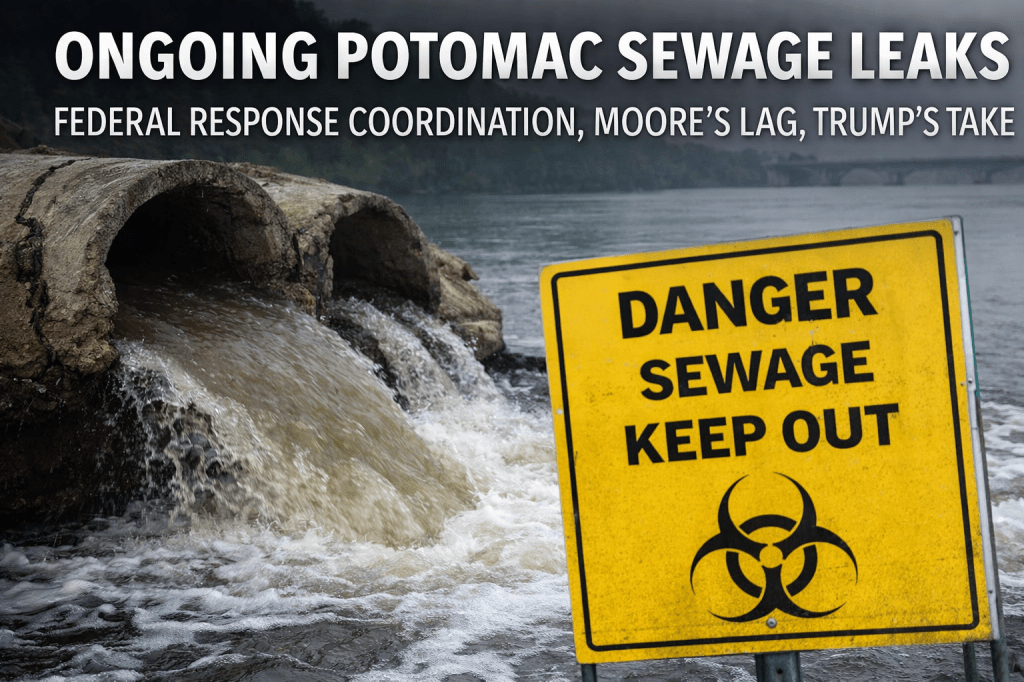
For more than a month, untreated wastewater has flowed into the Potomac River system following the collapse of a critical section of the Potomac Interceptor — a failure now widely described as one of the largest sewage spills in U.S. history.
The environmental damage is real. The public health concerns are real. The economic impact on the District and surrounding communities is real.
What has been less clear is Maryland Governor Wes Moore’s leadership.
A Month of Optics, Not Urgency
In the early days following the collapse, Marylanders and D.C. residents expected coordinated, aggressive action from state leadership. Instead, they saw political posturing.
Governor Moore publicly jabbed at President Trump, responding to a suggestion that federal support could be requested with: “Please, Mr. President, do your job.”
That line may play well on cable news. It does not clean rivers.
As raw sewage continued moving through the C&O Canal system and into the Potomac, residents wanted containment, mitigation, transparency, and environmental monitoring — not soundbites.
There were no immediate emergency declarations from Annapolis. No sustained public briefings outlining specific mitigation timelines. No visible interstate task force.
For a governor who campaigned on competence and results, the response has appeared reactive rather than proactive.
The White House Steps In
This week, the White House signaled that the federal government has been preparing plans and is in active coordination with FEMA, the Army Corps of Engineers, and the Environmental Protection Agency.
White House Press Secretary Karoline Leavitt stated that federal officials have been “standing by” and are prepared to provide next steps.
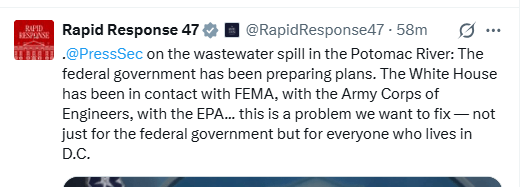
The message was clear: the federal government views this as a regional infrastructure crisis, not merely a local inconvenience.
That distinction matters.
The Potomac River is not just Maryland’s river. It is the drinking water source for millions in the District of Columbia and Northern Virginia. It feeds into the Chesapeake Bay, one of the nation’s most environmentally and economically important waterways.
When infrastructure fails at this scale, federal coordination is not political interference. It is governance.
Infrastructure Failure Meets Leadership Vacuum
The Potomac Interceptor is aging infrastructure. That much is undisputed. But aging infrastructure becomes a crisis when long-term maintenance, redundancy planning, and emergency contingencies are inadequate.
Residents now face:
- Elevated bacteria risks
- Disrupted recreational access
- Environmental damage to river ecosystems
- Ongoing repair timelines stretching weeks
And yet, for weeks, public communication from Maryland leadership remained muted.
When the federal government signaled willingness to engage, instead of collaborative tone, Maryland’s response escalated into partisan sparring.
That is not the posture of a state executive managing an environmental emergency.
Trump’s Calculated Federal Framing
President Trump’s response — pledging coordination with FEMA and the Army Corps — carries political implications, yes. But it also places responsibility squarely on outcomes.
If federal agencies engage, resources move faster. Technical capacity increases. Oversight tightens.
It also shifts the narrative away from rhetoric and toward measurable benchmarks:
- When will the bypass pumping be eliminated?
- When will environmental restoration begin?
- What is the total estimated discharge volume?
- Who bears financial responsibility?
These are operational questions, not partisan ones.
What This Means for D.C.
For District residents, the stakes are immediate:
- Drinking water safety
- Recreational river access
- Environmental compliance
- Public trust
Washingtonians do not care whether the solution carries a red label or a blue label. They care whether sewage stops flowing.
If Maryland leadership hesitates while Washington mobilizes, that contrast will not go unnoticed — particularly in a region where infrastructure accountability already runs thin.
The Bigger Lesson
The Potomac Interceptor collapse is not just an environmental story. It is a test of executive leadership under pressure.
One month in, the public still sees pumps, temporary bypasses, and vague timelines.
Leadership is not measured by how sharply you can respond to a political rival. It is measured by how quickly you restore systems and protect citizens.
The sewage in the Potomac does not care about party affiliation.
Voters might.
 Federal City News