By FCN Staff
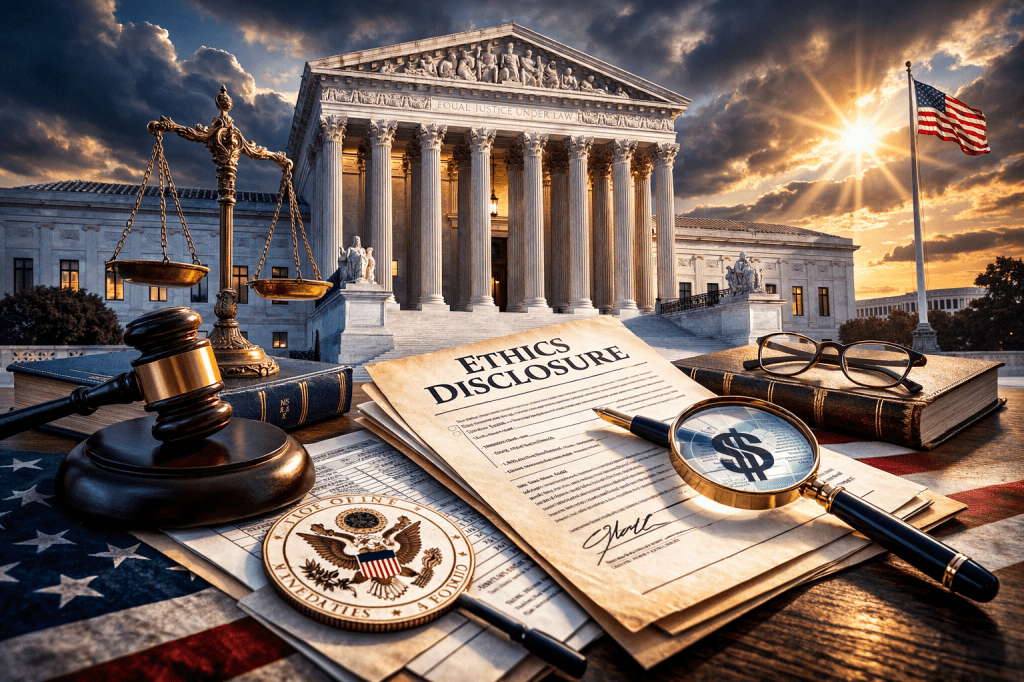
A new debate over ethics disclosures at the U.S. Supreme Court is once again putting the nation’s highest court under the political microscope.
According to recent reporting, lawmakers and advocacy groups are pushing for expanded financial disclosure requirements and stricter oversight mechanisms for the justices. Critics argue that recent controversies surrounding travel, gifts, and outside relationships have eroded public confidence in the Court. Supporters of reform say enhanced transparency is essential to preserving legitimacy.
But the fight unfolding around the Supreme Court is about more than disclosure forms. It is about institutional independence, separation of powers, and whether Congress should exert greater control over a co-equal branch of government.
The Push for More Disclosure
Members of Congress have advanced proposals aimed at tightening ethics rules for the Court. These proposals range from expanding reporting requirements to creating stronger enforcement mechanisms. Reform advocates argue that unlike lower federal judges—who are bound by a formal code of conduct—the Supreme Court historically operated with broader discretion.
In response to growing public scrutiny, the Court adopted a formal ethics code in recent years. Supporters of reform argue that this move was necessary but insufficient, claiming that additional statutory requirements are needed to ensure accountability.
The Constitutional Tension
Conservatives and constitutional scholars warn that Congress must tread carefully.
The Supreme Court is not an agency of Congress. It is a separate branch of government established under Article III of the Constitution. While Congress has authority to regulate aspects of the federal judiciary—such as budgets and administrative matters—attempts to impose intrusive oversight mechanisms raise separation-of-powers concerns.
The Founders deliberately insulated the judiciary from political pressure. Life tenure and salary protections were designed to prevent justices from being influenced by partisan winds. Expanding congressional control over internal judicial ethics could risk blurring those constitutional lines.
Public Trust vs. Political Weaponization
There is little doubt that public confidence in institutions—across all branches—has declined in recent years. That includes the Supreme Court. Transparency, in principle, is a nonpartisan value.
But critics of aggressive reform efforts argue that much of the current push is politically motivated. The Supreme Court has issued several landmark rulings in recent years that reshaped abortion law, administrative authority, and federal regulatory power. Some lawmakers who previously showed little interest in judicial ethics have become vocal advocates only after decisions they opposed.
That reality complicates the narrative. Is this about ethics reform? Or is it about dissatisfaction with jurisprudence?
A Sensible Path Forward
There is room for reasonable reform without compromising constitutional balance.
Clear disclosure standards, consistent reporting requirements, and transparent enforcement mechanisms can strengthen public confidence. At the same time, reforms must avoid creating avenues for Congress to pressure or punish justices based on controversial rulings.
The Supreme Court’s legitimacy ultimately rests not on popularity, but on adherence to the Constitution. Ethics rules should reinforce that mission—not transform the judiciary into a political battleground controlled by shifting congressional majorities.
As the debate unfolds, Americans would be wise to demand transparency from all three branches of government—while also preserving the constitutional guardrails that protect judicial independence.
In a time of declining institutional trust, striking that balance matters more than ever.
 Federal City News