By FCN Staff
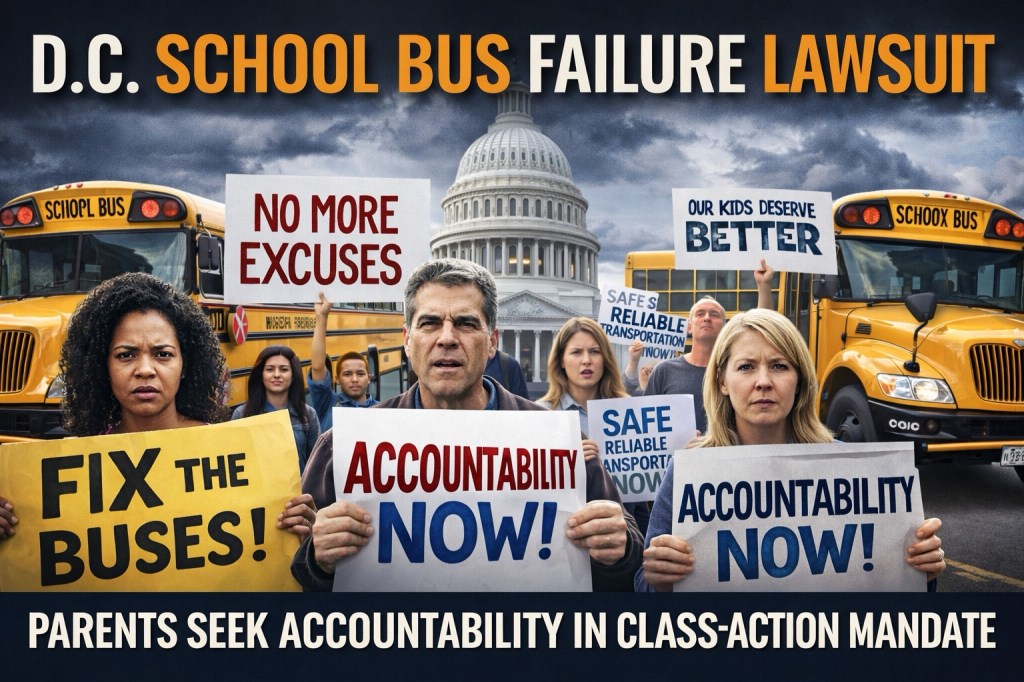
A new class-action lawsuit filed against the District alleges what many D.C. families have been saying for years: the city’s school transportation system is unreliable, dysfunctional, and failing some of its most vulnerable students.
According to reporting by WTOP, parents have sued over chronic delays and missed pickups involving D.C.’s Office of the State Superintendent of Education (OSSE), which oversees transportation services for students — particularly those with disabilities who rely on specialized bus routes.
For families like Elizabeth Daggett’s, the issue is not theoretical. For over a decade, she has reportedly had to wonder whether a bus would arrive at all to take her son to school. That uncertainty, parents argue, has disrupted learning, strained working families, and in some cases jeopardized federally protected educational rights.
A System Under Strain — Or a System Mismanaged?
Transportation failures in the District are not new. For years, OSSE’s Division of Transportation (DOT) has faced complaints over late buses, inconsistent service, and staffing shortages. The pandemic and labor market challenges have been cited as contributing factors.
But parents involved in the lawsuit argue that this is more than a temporary staffing issue. They claim the dysfunction has been systemic and longstanding — and that the District has failed to implement durable reforms despite repeated warnings.
If true, that raises difficult questions for D.C.’s leadership.
Washington is one of the highest-spending jurisdictions in the country when measured per pupil. Yet families are now alleging that even basic operational functions — like reliably getting children to school — cannot be guaranteed.
That disconnect between funding levels and service delivery is becoming a recurring theme in District governance.
Impact on Students With Disabilities
The legal stakes may be particularly high because many of the affected students reportedly receive services under the Individuals with Disabilities Education Act (IDEA). Under federal law, districts must provide transportation when it is necessary for a child to access a free and appropriate public education.
Repeated missed pickups or extreme delays could raise compliance concerns under federal special education requirements.
Parents argue that unreliable transportation effectively denies their children access to school — and by extension, access to legally mandated services.
If the court agrees that the District has failed to meet those obligations, the case could have significant financial and policy consequences.
Accountability Gap in the District
This lawsuit arrives at a time when D.C. leadership is already facing fiscal pressure and operational scrutiny. The city has warned of budget strain, debated tax reforms, and struggled with high-profile infrastructure and public safety issues.
The bus crisis adds to a growing perception that core government functions are faltering while administrative overhead and spending continue to expand.
In most private-sector environments, a decade-long failure to deliver a basic service would result in sweeping restructuring. In government, however, the incentives often point toward incremental fixes rather than structural accountability.
Parents appear to be signaling that incremental change is no longer acceptable.
What Happens Next?
The class-action status means the case could represent a broad group of affected families, not just a handful of plaintiffs. That significantly raises the stakes for the District.
Possible outcomes range from mandated reforms and court oversight to financial settlements. In some cities, transportation systems have been placed under strict performance monitoring following similar litigation.
For D.C. families, however, the question is simpler: Will the bus show up tomorrow?
At its core, this case is not about politics. It is about competence. It is about whether the District can reliably perform one of the most basic responsibilities of public education — getting children to school safely and on time.
If city leaders want to avoid further legal intervention, the path forward is clear: transparency, measurable benchmarks, independent oversight, and consequences for continued failure.
Until then, parents are turning to the courts.
And that, in itself, is an indictment of the system.
 Federal City News