
Mayoral hopeful enters federal crossfire over sewage collapse response
By FCN Staff
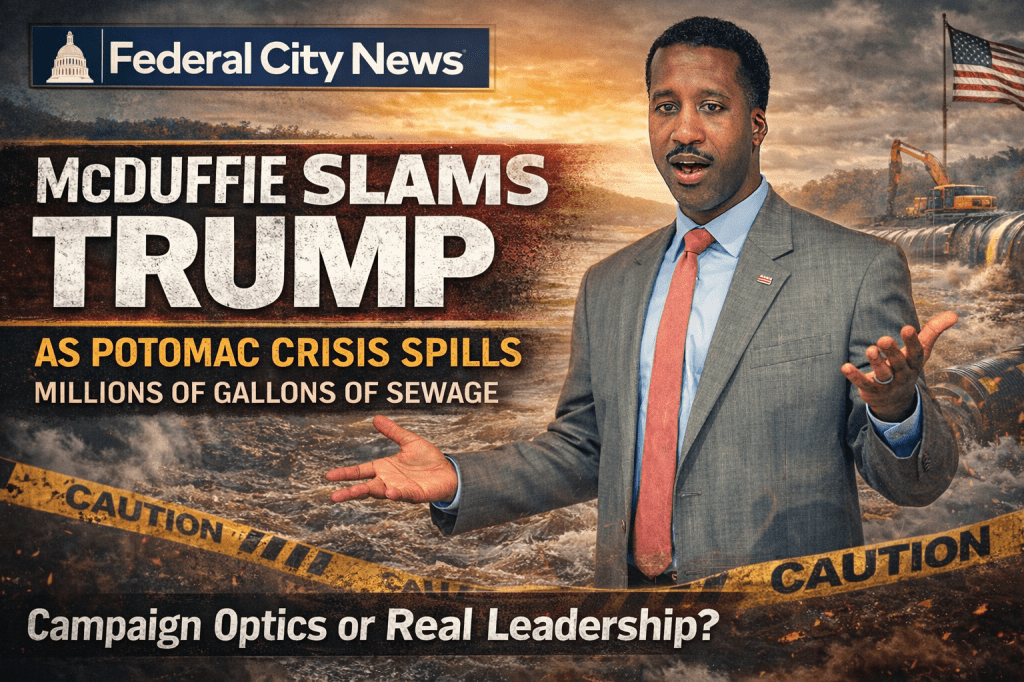
As the fallout from the Potomac Interceptor collapse continues to unfold, D.C. mayoral candidate Kenyan McDuffie has stepped directly into the political fight between President Donald Trump and Maryland Governor Wes Moore.
In a public statement, McDuffie accused Trump of “using an emergency situation as a political weapon” after the president signaled willingness to deploy federal resources, including FEMA support, to assist in the response to the massive wastewater infrastructure failure in Maryland.
McDuffie emphasized that D.C.’s drinking water remains safe and that the Environmental Protection Agency is already coordinating with DC Water. He dismissed additional federal involvement as “grandstanding.”
But in doing so, McDuffie may have created a new question for D.C. voters: When a regional infrastructure failure spills across jurisdictions, is reflexively rejecting federal assistance the posture of a future executive?
A Multi-Jurisdictional Crisis
The Potomac Interceptor collapse was not a minor maintenance issue. It involved a major wastewater line failure that released hundreds of millions of gallons of untreated sewage into the river system. Elevated bacterial levels were detected downstream, and environmental monitoring continues.
The Potomac River serves Maryland, D.C., and Virginia. It is not confined to a single political boundary.
That reality complicates the “local control versus federal intrusion” narrative. Interstate waterways and large-scale environmental hazards often trigger federal coordination precisely because their impacts do not stop at city lines.
If the EPA is already engaged, the question becomes less about sovereignty — and more about whether additional federal resources would accelerate containment, remediation, or infrastructure stabilization.
Politics Versus Executive Judgment
McDuffie framed Trump’s involvement as partisan theater. That may resonate with some Democratic primary voters. But general election voters — and independent D.C. residents — may evaluate the moment differently.
Executive leadership in crisis is rarely about rhetorical positioning. It is about results.
When the federal government offers assistance during a large-scale environmental event, declining or criticizing that assistance carries risk. Voters may ask:
- Would a Mayor McDuffie accept federal logistical or financial support if it benefits District residents?
- Or would partisan dynamics dictate the response?
- Is the focus on coordination — or confrontation?
D.C. is uniquely dependent on federal cooperation. Its budget, security posture, infrastructure funding, and regulatory environment all operate within a federal framework. A mayor cannot govern effectively without navigating that reality.
The Optics Problem
McDuffie is correct that D.C.’s drinking water has not been declared unsafe. That reassurance matters.
But political messaging that appears dismissive of federal engagement — particularly during a widely publicized infrastructure collapse — may not project calm, competent leadership.
Voters tend to reward executives who demonstrate steadiness and cooperation during crisis. They tend to punish those perceived as escalating partisan disputes while remediation remains ongoing.
The Potomac situation is not just about sewage lines. It is about confidence in infrastructure oversight, transparency in response, and the ability of leaders across jurisdictions to work together when systems fail.
A Test of Mayoral Temperament
Mayoral campaigns often pivot on intangible qualities: judgment, temperament, and decision-making under pressure.
By entering the Trump–Moore dispute in explicitly partisan terms, McDuffie has signaled where he stands politically. The open question is whether that positioning reflects the executive style D.C. voters want in City Hall.
Washington is not just another city. It is the seat of federal power. Its mayor must regularly negotiate, collaborate, and occasionally compromise with administrations of both parties.
The Potomac Interceptor collapse may be an infrastructure story — but it has quickly become a leadership story.
 Federal City News