
By FCN Staff
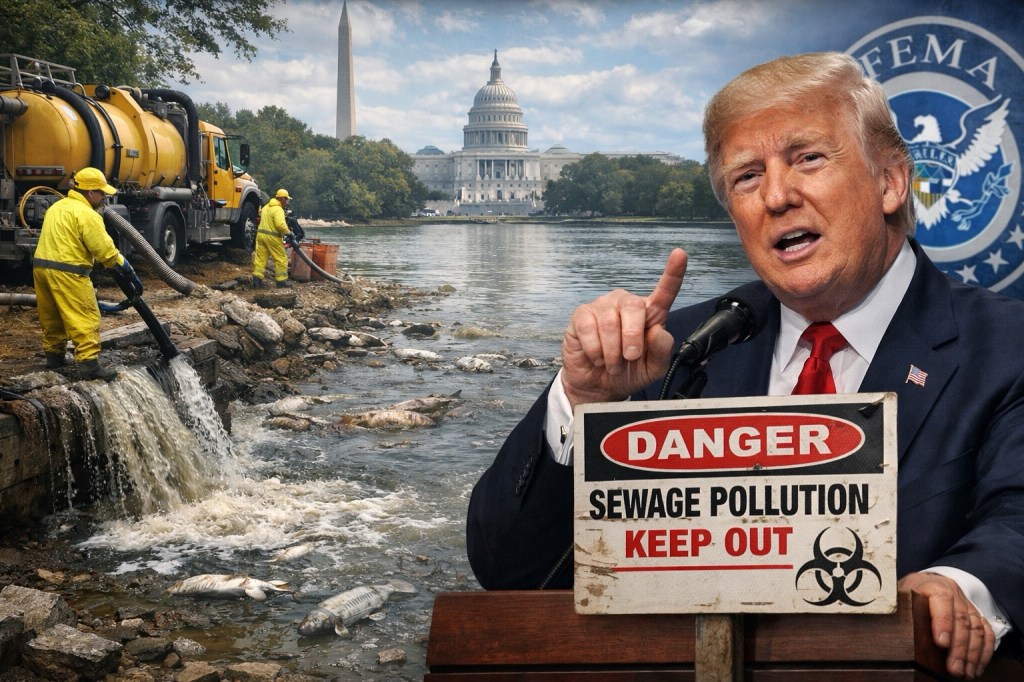
Washington, D.C. — President Donald Trump says the federal government is prepared to step in through FEMA to assist with cleanup and mitigation efforts stemming from the catastrophic rupture of the Potomac Interceptor sewer line — a failure that has already released hundreds of millions of gallons of untreated wastewater into the Potomac River corridor.
The collapse of the 72-inch interceptor pipe, managed by DC Water, has triggered widespread contamination concerns across the region, including elevated E. coli readings and downstream environmental impacts affecting Washington, D.C., Maryland, and Northern Virginia.
According to reporting by Fox Baltimore, Trump signaled that FEMA resources could be deployed if requested, emphasizing that “clean water and public health are not partisan issues.” The spill is being described by some environmental observers as one of the largest wastewater discharge events in recent U.S. history.
A Regional Crisis With National Implications
The Potomac River is not only a symbolic waterway flowing past the monuments of Washington — it is also a source of drinking water and economic vitality for the region. The breach has contaminated portions of the river and the adjacent C&O Canal National Historical Park, raising concerns about tourism, fishing, and public safety.
The wastewater is typically routed through the Potomac Interceptor to the Blue Plains Advanced Wastewater Treatment Plant in Southwest D.C. Any prolonged failure in the system increases pressure on emergency bypass mechanisms and heightens the risk of additional environmental damage.
Public health officials have warned residents about contact with river water and have issued advisories in affected areas.
Criticism of Maryland’s Response
While the rupture occurred in Montgomery County, Maryland, critics argue that Gov. Wes Moore has remained largely silent during what many view as a major environmental emergency on Maryland soil.
Moore’s administration has previously touted infrastructure investment and environmental stewardship. However, center-right critics contend that a spill of this magnitude demands executive-level visibility and coordination — especially given the cross-border impact on Washington, D.C.
The absence of a forceful state-led response has prompted renewed debate about infrastructure oversight, interstate utility coordination, and the aging wastewater systems serving the National Capital Region.
Federalism in Action — or Breakdown?
Trump’s pledge to leverage FEMA reflects a broader theme in his current posture toward disaster response: federal assistance where states appear overwhelmed or slow to act.
FEMA intervention would typically require a formal disaster declaration or request from state authorities. Whether Maryland will formally seek such assistance remains unclear.
In the meantime, Washington-area residents continue to deal with contamination advisories, lingering odor complaints, and mounting frustration.
The Bigger Picture
The Potomac Interceptor collapse underscores the fragile state of critical infrastructure in the nation’s capital region. It also raises questions about accountability between local utilities, state leadership, and federal oversight.
If FEMA becomes involved, it could signal a rare instance where environmental infrastructure failure — rather than a hurricane or wildfire — triggers a robust federal disaster response.
For residents of Washington, D.C., the issue is not political theater. It is about clean water, public health, and competent governance.
As the situation unfolds, the pressure will remain on state and local officials to demonstrate leadership — and on the federal government to ensure that the Potomac, a defining river of the American republic, is restored safely and swiftly.
 Federal City News