By FCN Staff
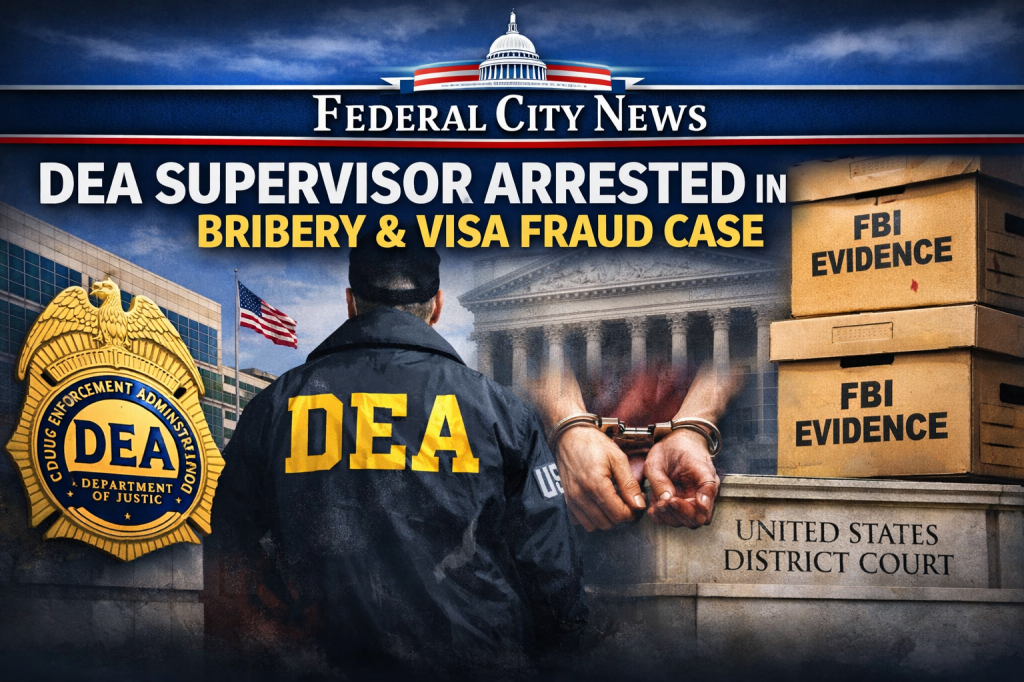
A supervisor with the Drug Enforcement Administration has been arrested and charged in a sweeping federal case alleging bribery conspiracy and visa fraud, according to an announcement by the U.S. Attorney’s Office for the District of Columbia.
The charges, filed in federal court in Washington, accuse the DEA official of abusing his position of authority in exchange for personal benefits tied to immigration-related favors. The case is being prosecuted with assistance from the U.S. Department of Justice and investigative partners, including the Federal Bureau of Investigation.
While the allegations remain just that—allegations—the case underscores a broader issue that transcends partisan politics: corruption within federal law enforcement erodes public trust and weakens the very institutions tasked with enforcing the law.
What the Charges Allege
According to prosecutors, the DEA supervisor allegedly participated in a bribery conspiracy involving immigration benefits. The indictment claims he leveraged his position to assist with visa-related matters in exchange for financial or personal gain. Federal authorities allege that this conduct violated bribery statutes and immigration fraud laws.
If proven, such conduct would represent not just personal misconduct but a betrayal of public trust in an agency charged with combating international narcotics trafficking and organized crime.
The defendant is presumed innocent unless and until proven guilty in a court of law.
A Reminder That Oversight Must Be Real
For years, policymakers have debated federal accountability—particularly in Washington, D.C., where numerous agencies operate with national authority but local impact.
Cases like this raise uncomfortable but necessary questions:
- Are internal oversight systems robust enough?
- Do federal agencies conduct adequate background and financial disclosure reviews?
- Are whistleblower protections sufficient to encourage reporting?
- Is congressional oversight focused on performance, or politics?
Corruption within law enforcement agencies is particularly damaging because these institutions depend on public credibility. When federal officers are accused of selling access or abusing immigration systems, it feeds public skepticism about unequal enforcement.
Immigration Integrity Matters
Visa fraud is not a technicality. The U.S. immigration system is already under strain, with intense national debate over border security, visa overstays, asylum backlogs, and enforcement priorities.
If a federal law enforcement supervisor exploited immigration pathways for profit, it reinforces concerns that the system can be manipulated by insiders—not just by those attempting to enter unlawfully.
That reality should prompt bipartisan interest in tightening compliance safeguards across federal agencies that interact with immigration authorities.
Cleaning House Strengthens Institutions
There is an important distinction between attacking institutions and demanding accountability within them.
Holding a DEA official accountable—if the charges are substantiated—does not weaken law enforcement. It strengthens it. Public confidence depends on swift and transparent action when misconduct surfaces.
The DOJ’s willingness to prosecute one of its own agency supervisors sends a message that no badge confers immunity.
The Bigger Picture in Washington
This case emerges at a time when federal agencies face increased scrutiny over internal ethics, politicization concerns, and public confidence. In a city where federal power is concentrated, ethical lapses have national implications.
For D.C. residents, the story is not abstract. Federal corruption cases play out in local courts, involve local juries, and shape the reputation of the city as the seat of national governance.
The rule of law must apply equally—from the street-level offender to the federal supervisor.
What Happens Next
The defendant will appear in federal court in Washington. Prosecutors will have to prove the elements of bribery conspiracy and visa fraud beyond a reasonable doubt.
If convicted, penalties could include substantial prison time, fines, and permanent loss of federal employment.
In the meantime, the case stands as a reminder that accountability must be consistent. Law enforcement agencies demand integrity from the public; the public has every right to demand it in return.
Federal City News Analysis:
Institutional integrity is not a partisan issue. Whether the misconduct involves immigration systems, procurement contracts, or abuse of authority, transparency and enforcement are essential. Washington cannot credibly demand accountability from others if it fails to enforce it within its own ranks.
 Federal City News