Federal Authority Reasserted as Congress Reminds District Who Holds the Purse Strings
By FCN Staff
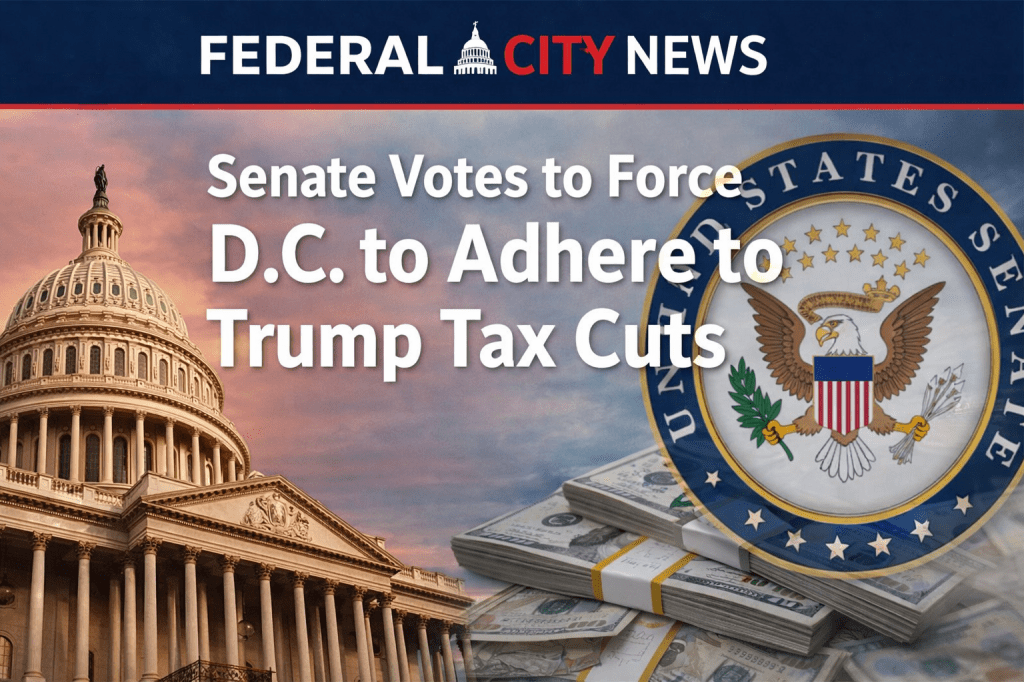
Washington’s uneasy experiment with “home rule” met constitutional reality this week as the U.S. Senate passed legislation requiring the District of Columbia to comply with federal tax law changes enacted under former President Donald Trump.
The bill, approved by the Senate and now moving toward final action, would effectively prevent D.C. officials from sidestepping or counteracting portions of the Trump-era tax cuts in the city’s local tax code.
For District leaders who have long sought greater autonomy — and even statehood — the vote is a stark reminder: Congress retains ultimate authority over the nation’s capital.
Congress Reasserts Its Constitutional Authority
Under the Constitution, Congress has exclusive legislative authority over the District of Columbia. While the 1973 Home Rule Act granted D.C. the ability to manage local affairs, Congress maintains the power to review, override, or impose laws on the District.
Supporters of the Senate measure argue that if D.C. wants to function as the seat of the federal government, it cannot operate as a political counterweight to federal law — especially on taxation.
“This is about consistency and fairness,” said one Republican senator during debate. “The capital of the United States should not selectively disregard federal tax policy while benefiting from federal spending.”
The legislation essentially blocks D.C. from implementing tax structures that would neutralize or override provisions of the 2017 Tax Cuts and Jobs Act. That law lowered federal income tax rates, reduced corporate taxes, and altered deduction frameworks nationwide.
Why This Matters for D.C. Residents
D.C. officials have argued that local tax flexibility is necessary to balance the city’s budget and protect social programs. The District faces structural budget pressures, including soaring healthcare and childcare costs, as Mayor Muriel Bowser has recently warned.
But critics on Capitol Hill contend that D.C.’s leadership cannot demand billions in federal support while simultaneously designing a local tax code that undermines federal policy.
From a center-right perspective, the broader issue is this: if D.C. seeks expanded powers akin to statehood, it must also accept the constitutional trade-offs embedded in its current status.
Congress has intervened before on D.C. matters ranging from criminal justice reforms to public safety funding. The Senate’s latest move signals a renewed willingness — particularly under a Republican majority — to assert that authority more aggressively.
The Political Subtext
The vote also carries symbolic weight.
Democratic lawmakers from D.C., including Eleanor Holmes Norton, have long pushed for greater fiscal independence and statehood. But Republicans have increasingly framed D.C.’s fiscal maneuvers as partisan experiments conducted within a federally funded jurisdiction.
With the 2026 elections looming, the message from Senate Republicans is clear: the capital city will not be allowed to chart an independent tax path that contradicts federal law.
The bill now awaits further procedural steps, but its passage in the Senate underscores a larger shift in the balance of power between Congress and the District.
What Happens Next?
If enacted, the legislation would:
- Require D.C. to conform its tax policies to federal changes under the Trump tax framework
- Limit the District’s ability to create offsetting tax structures
- Reinforce congressional oversight over D.C.’s fiscal policy
Expect legal and political pushback from District officials. But unless Congress itself reverses course, the constitutional hierarchy is clear.
The Bigger Question
This episode reignites a long-running debate:
- Can D.C. claim near-state autonomy while remaining constitutionally subordinate to Congress?
- Should federal taxpayers subsidize a city that openly resists federal tax policy?
- And what does “home rule” really mean when federal authority is absolute?
For now, the Senate has answered at least one of those questions.
The nation’s capital may govern itself day to day — but when it comes to taxes, Congress still calls the shots.
 Federal City News