
By FCN Staff
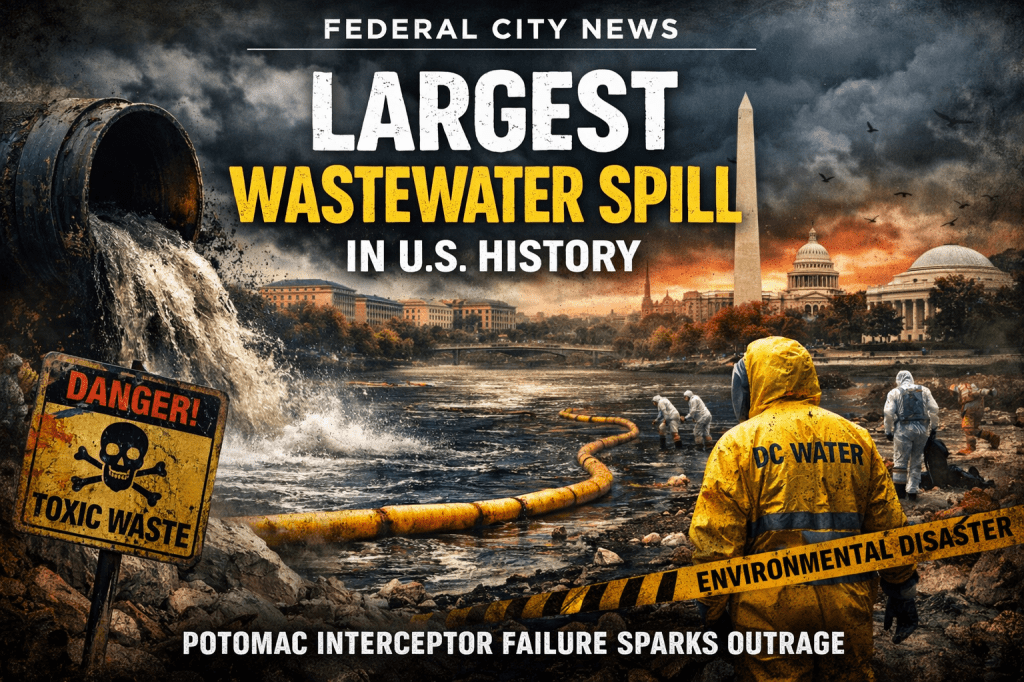
The failure of the Potomac Interceptor is no longer just a maintenance concern. It has now been described as the largest spill of wastewater in U.S. history, placing extraordinary pressure on DC Water and the District’s political leadership.
In his open letter, CEO David L. Gadis acknowledged the seriousness of the situation surrounding the Potomac Interceptor system—an essential artery carrying wastewater to the Blue Plains Advanced Wastewater Treatment Plant.
This is not a routine infrastructure hiccup. It is a historic environmental and operational failure with national implications.
What Happened
The Potomac Interceptor, a massive underground sewer line that serves portions of D.C. and Northern Virginia, experienced a structural failure that resulted in an unprecedented wastewater spill.
The scope and volume reportedly exceed previous incidents nationwide.
That fact alone demands a level of scrutiny beyond typical utility maintenance discussions. When infrastructure failure reaches historic scale, questions inevitably follow:
- How long were warning signs present?
- Were inspections sufficient?
- Was rehabilitation deferred?
- Were funding or regulatory trade-offs involved?
Infrastructure Leadership—or Deferred Responsibility?
Washington has prided itself on environmental progress, especially after investing billions in large-scale tunnel projects to reduce combined sewer overflows under federal consent decrees.
Ratepayers have absorbed substantial increases to fund those projects.
Yet despite that spending, a core interceptor system deteriorated to the point of catastrophic failure.
This raises uncomfortable but necessary questions about prioritization. Were capital dollars directed toward the highest-risk assets? Was long-term structural integrity given adequate attention? Or did compliance-driven projects crowd out equally urgent rehabilitation work?
Transparency is welcome. But accountability is required.
The Cost to Ratepayers
Now comes the financial reckoning.
Emergency response, environmental mitigation, structural rehabilitation, and potential federal enforcement actions will carry significant costs. Those costs will ultimately fall somewhere:
- On ratepayers
- On District taxpayers
- Or through federal intervention
Washingtonians already pay among the highest water and sewer rates in the region. Another round of steep increases—without clear structural reform—will test public patience.
If this truly is the largest wastewater spill in U.S. history, then the response must reflect that scale.
Environmental and Public Health Impact
Beyond budgets, there is the environmental consequence.
The Potomac River is not just a local waterway; it is a regional ecological and economic asset. Wastewater discharge at historic levels raises legitimate concerns about water quality, downstream impact, and long-term remediation.
Federal environmental regulators will almost certainly scrutinize this event closely. If enforcement actions follow, the District’s financial exposure could grow.
A Moment of Institutional Reckoning
The real issue is not whether infrastructure ages—it does.
The issue is whether systems were monitored, maintained, and prioritized appropriately before reaching failure.
Large cities across America are confronting similar aging infrastructure challenges. But when a failure reaches record-breaking proportions, it becomes a case study in governance.
The District must provide:
- A full independent review of inspection and maintenance practices
- A public accounting of prior risk assessments
- A detailed, time-bound remediation plan
- Clear cost projections and funding strategies
Anything less invites skepticism.
What Comes Next
The Potomac Interceptor runs underground, out of sight. But its failure is now highly visible.
City leaders often focus on new programs, social initiatives, and symbolic policy debates. Yet basic infrastructure—water, sewer, power—remains the backbone of urban life.
If Washington cannot safeguard its most fundamental systems, confidence in broader governance erodes.
This moment demands seriousness, transparency, and fiscal discipline.
Because when the largest wastewater spill in U.S. history happens on your watch, incremental responses will not suffice.
 Federal City News