By Federal City News Staff
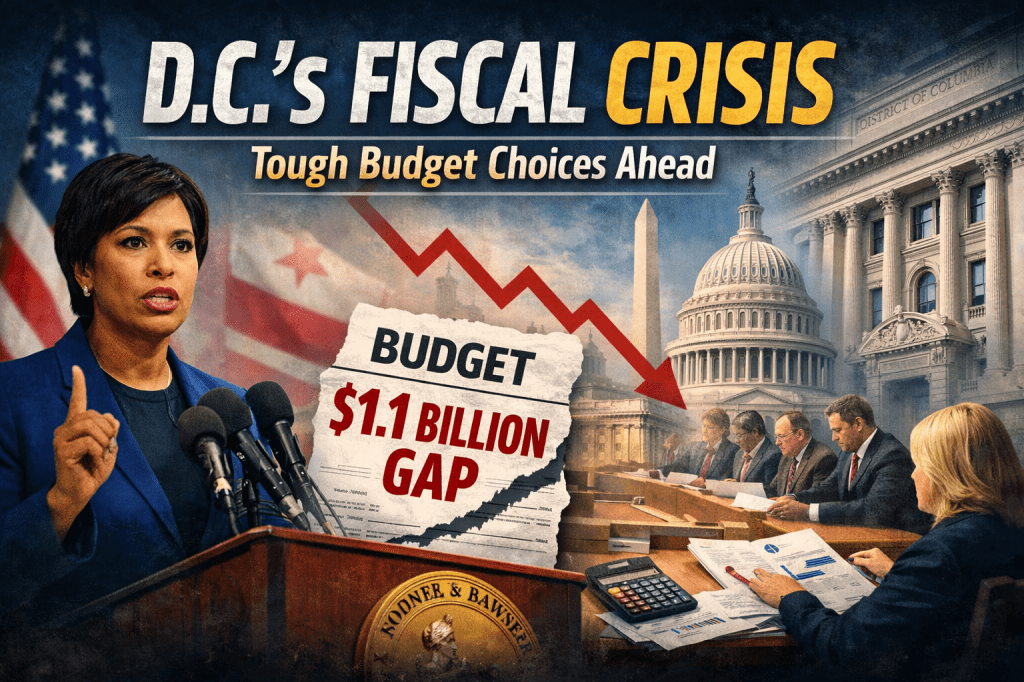
Washington, D.C. is entering what could be its most difficult budget season in years.
According to reporting from The Washington Post, Muriel Bowser and her administration told members of the D.C. Council this week that maintaining current programs and services would require roughly $1.1 billion in additional revenue — a staggering figure for a city already facing economic uncertainty, soft commercial real estate markets, and long-term structural pressures.
The message from City Hall was blunt: fiscal pain is coming, and tough policy trade-offs are unavoidable.
The Programs on the Chopping Block
Two major cost drivers are at the center of the warning:
- Health care programs for lower-income residents
- Child care subsidy programs
Both have grown rapidly in cost, driven by expanded eligibility and rising provider reimbursements.
Administration officials signaled that health care programs could see narrower eligibility and stricter rules over the next several years. Meanwhile, the child care subsidy program — one of the most generous in the country — may be capped, limiting how many families qualify for assistance.
D.C. already has some of the highest child care costs in the nation. Capping eligibility may help stabilize spending, but it also risks squeezing middle- and working-class families who depend on subsidies to remain in the workforce.
The uncomfortable truth is this: generosity without guardrails eventually collides with math.
A Structural Problem, Not a Temporary Dip
D.C.’s fiscal stress is not merely cyclical.
The city’s tax base remains heavily dependent on:
- Commercial office property taxes
- Income taxes from high earners
- Federal workforce stability
With remote work reducing office occupancy and uncertainty surrounding federal employment levels, revenue growth has slowed. Meanwhile, spending commitments made during stronger years — including expanded social programs — continue to rise automatically.
In effect, the District built long-term obligations on short-term revenue assumptions.
Now the bill is coming due.
The Trade-Off Question
The administration’s warning forces a central question for council members:
Does D.C. continue expanding eligibility for social programs — or does it prioritize fiscal sustainability?
A center-right perspective suggests three realities policymakers must confront:
- Programs must be sustainable, not symbolic. Expanding eligibility without stable funding creates instability later.
- Economic growth matters. The District cannot tax its way out of structural imbalance without risking business flight.
- Spending discipline is not cruelty. It is stewardship.
There is a difference between protecting vulnerable residents and expanding benefits beyond what long-term revenues can support.
What This Means for Residents
For Washingtonians, especially working families and small business owners, this budget season could bring:
- Tighter subsidy eligibility
- Higher fees or taxes in other areas
- Reduced service growth
- Greater scrutiny of program costs
The political challenge for Muriel Bowser and the D.C. Council will be deciding whether to reform programs now — or defer difficult decisions and risk even larger deficits later.
The Broader Implication
D.C.’s situation is a cautionary tale for blue cities nationwide.
When economic conditions are strong, expanding benefits is politically easy. When revenues tighten, reform becomes politically painful.
The question now is whether the District will embrace fiscal realism — or attempt to preserve every promise through accounting maneuvers and short-term fixes.
Because the numbers don’t negotiate.
And $1.1 billion is not a rounding error.
 Federal City News