
By Federal City News Staff
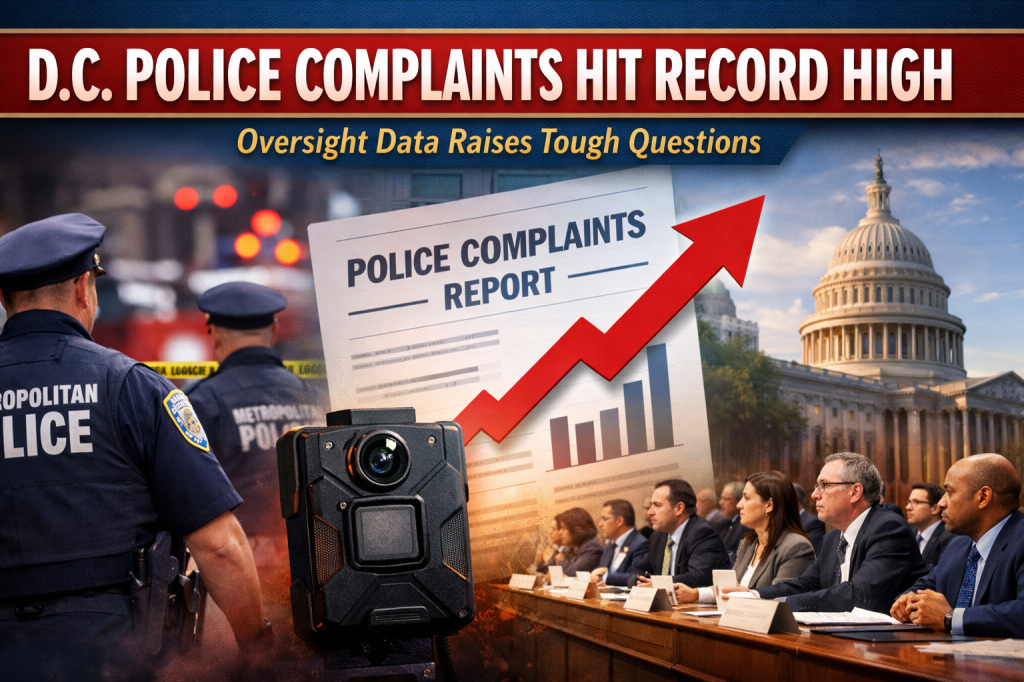
Complaints against officers in Washington, D.C.’s Metropolitan Police Department reached a record high in Fiscal Year 2025, according to a newly released annual report from the Office of Police Complaints (OPC).
At first glance, the numbers appear alarming. A closer look, however, suggests a more complicated story—one that raises questions about policing policy, officer training, and the effectiveness of D.C.’s growing oversight bureaucracy.
The Headline Numbers
According to the OPC report, complaints filed by the public increased 13 percent year over year, rising from 943 in FY 2024 to 1,065 complaints in FY 2025—the highest total since the agency’s creation.
Allegations tied to those complaints rose even faster, up 26 percent to 1,955 total allegations. The most common categories were:
- Harassment (51%)
- Unprofessional conduct or language (22%)
- Unnecessary or excessive force (15%)
Yet despite the surge in filings, OPC investigators fully examined only 648 complaints, and just 10 cases—less than one percent—were ultimately sustained.
That gap between volume and outcomes is becoming the central tension in the city’s police accountability debate.
Body Cameras: Progress, But Still Problems
Body-worn cameras were involved in 81 percent of investigated cases, reinforcing how central the technology has become to modern policing in the District. Officers failed to comply with camera activation or usage rules in 17 percent of those incidents—an improvement from 33 percent the previous year, but still a significant compliance gap.
Supporters of reform point to the progress. Critics argue that after years of mandates, training, and discipline policies, partial compliance is not good enough.
Younger Officers, Higher Complaints
One of the more striking findings in the report involves officer demographics. Officers under the age of 35 make up about 35 percent of MPD’s force but accounted for 43 percent of complaints. More than 80 percent of complaints involved male officers.
The data raises uncomfortable questions for city leaders: Are newer officers receiving adequate preparation? Are recruitment standards aligned with the realities of high-pressure urban policing? Or are younger officers simply bearing the brunt of increased enforcement expectations amid staffing shortages?
Oversight Expansion Meets Skepticism
The OPC’s Police Complaints Board issued four new policy recommendations, including improved documentation for stop-and-frisk encounters and clearer guidance on interactions with licensed firearm carriers. These recommendations, however, are advisory only—MPD retains final authority over whether to adopt them.
OPC Executive Director Marke Cross defended the rising complaint totals as a sign of increased public trust and transparency, emphasizing that OPC investigates only civilian-filed complaints, not internal MPD discipline.
The city’s police union was less impressed. Union leaders questioned whether a $3.3 million annual budget is justified when the sustain rate remains so low, arguing that raw complaint numbers can be misleading and politically weaponized.
The Broader Context
The report lands as D.C. continues to wrestle with crime, officer recruitment challenges, and public confidence in law enforcement. Mayor Muriel Bowser has repeatedly emphasized the need for both accountability and public safety, but the OPC data underscores how difficult it is to strike that balance.
For residents, the question isn’t simply whether complaints are rising—but whether the system is producing better policing outcomes, clearer standards, and fair treatment for both officers and citizens.
What Comes Next
The OPC report offers no easy answers. It does, however, highlight a persistent pattern in modern urban governance: expanding oversight structures without clear evidence that they are improving conduct, morale, or public safety.
As the District debates further reforms, policymakers may need to look beyond headline complaint totals and ask a tougher question—whether current accountability models are actually delivering the accountability they promise, or merely adding another layer of bureaucracy to a police force already under strain.
 Federal City News