
By FCN News
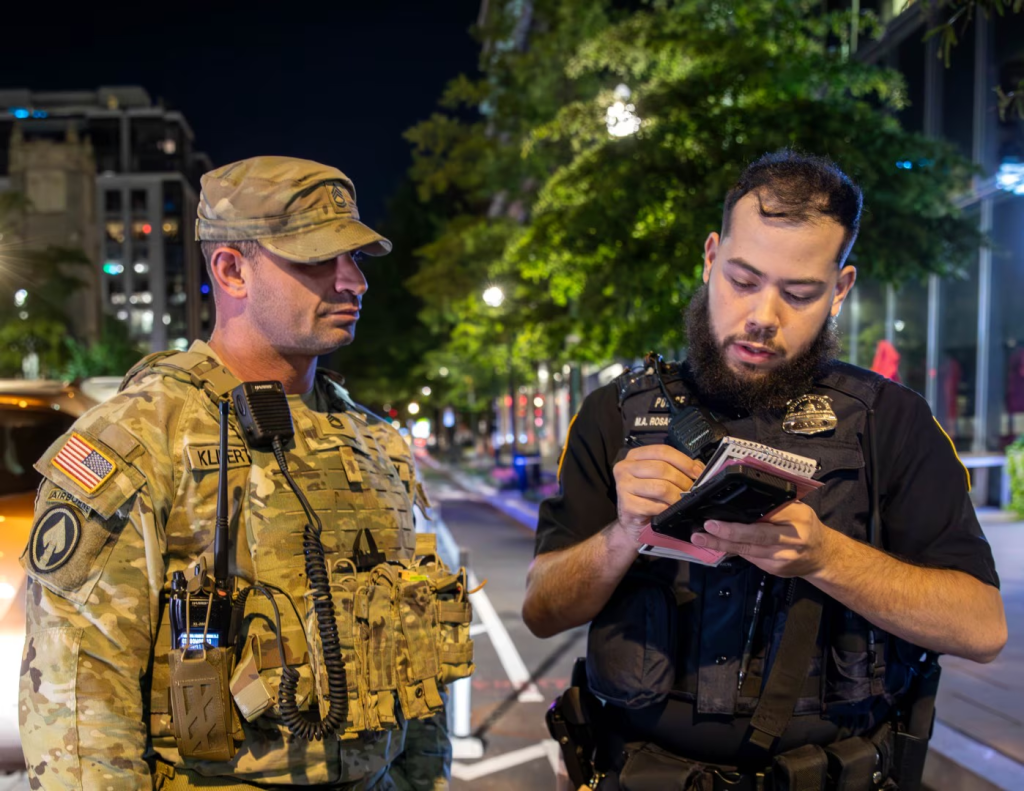
A new report from Democrats claims that the deployment of the National Guard in Washington, D.C. had no measurable impact on crime. The conclusion, highlighted this week by Stars and Stripes, is already being embraced by progressive activists eager to argue that visible security and federal assistance are unnecessary—or even counterproductive.
But for many residents, commuters, and business owners, the report raises more questions than it answers.
A Narrow Lens on a Broader Problem
The Democratic report focuses on crime statistics during periods when National Guard troops were deployed in the District, concluding that crime trends did not significantly change. On paper, that sounds definitive.
In reality, it relies on a narrow set of metrics and a short timeframe—while ignoring the broader context of D.C.’s ongoing public safety crisis.
Violent crime in the District has surged in recent years, with carjackings, armed robberies, and homicides becoming regular features of local headlines. Against that backdrop, expecting short-term Guard deployments to single-handedly reverse long-term crime trends is a straw man argument.
The Guard was never intended to replace policing or solve root causes of crime. Its role was stabilization—supporting overwhelmed local resources, protecting federal property, and restoring a basic sense of order during periods of unrest or heightened threat.
Deterrence Isn’t Always Captured in Spreadsheets
Crime statistics don’t measure everything.
They don’t capture crimes that didn’t happen because of visible security. They don’t reflect deterrence effects, faster response coordination, or the psychological impact on law-abiding residents who felt safer seeing uniformed personnel on the streets.
For downtown workers returning to offices, tourists navigating the National Mall, and residents living near federal buildings, the presence of the National Guard often signaled that the government was at least trying to maintain order.
Dismissing that entirely because it doesn’t show up cleanly in a crime chart misses the lived reality of public safety.
Politics First, Public Safety Second?
The timing and framing of the report are hard to ignore.
As Democrats face growing voter frustration over crime—especially in major cities—there is increasing pressure to downplay enforcement-based approaches and shift the conversation toward long-term social investments. While those investments matter, they are not substitutes for immediate safety.
By declaring the Guard ineffective, critics can argue against future deployments while avoiding tougher conversations about understaffed police departments, slow prosecutions, and policies that prioritize ideology over enforcement.
In other words: if enforcement “doesn’t work,” no one has to admit that enforcement was never fully tried.
The Guard Was Never the Problem
The real question isn’t whether the National Guard magically reduced crime rates. It’s why D.C. leaders have struggled to deliver basic public safety with or without federal support.
Blaming the Guard—or using selective data to argue it was pointless—feels less like serious analysis and more like political cover.
Washington doesn’t need fewer tools to address crime. It needs leaders willing to use all of them responsibly.
Bottom Line
The Democratic report may satisfy activists and talking points, but it does little to reassure a city still grappling with violence and disorder.
For many Washingtonians, the issue isn’t whether the National Guard “worked” on a spreadsheet. It’s whether anyone in power is serious about restoring safety at all.
 Federal City News