By FCN Staff
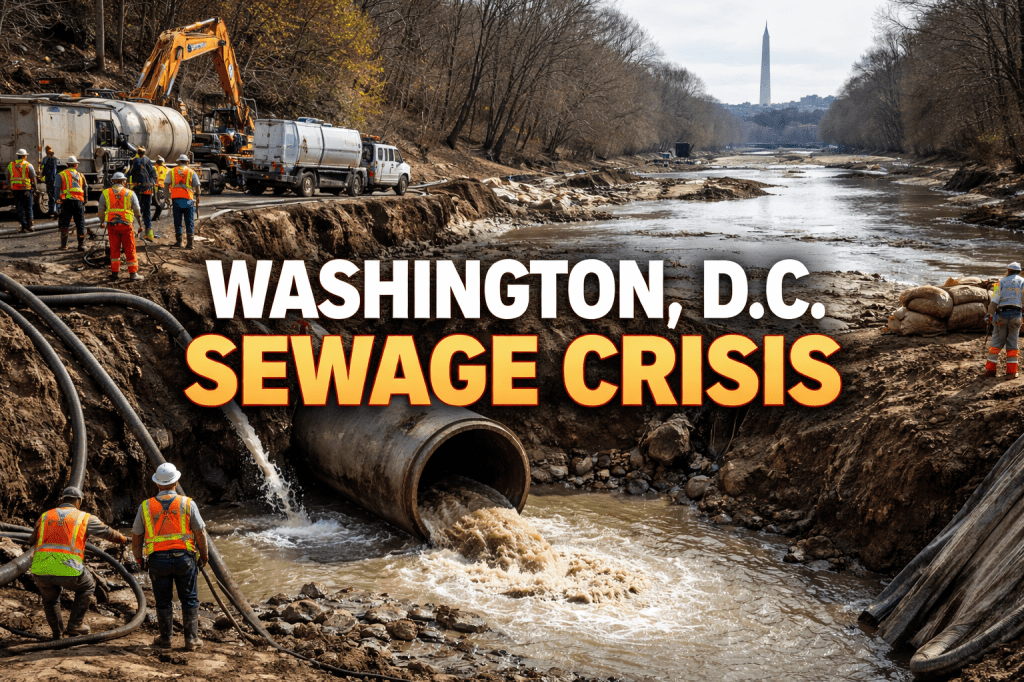
Washington, D.C. residents are now being told that a massive sewage leak fouling parts of the city will take weeks longer to repair than originally projected—a delay that has reignited concerns about infrastructure mismanagement, transparency, and accountability in the nation’s capital.
According to reporting from WTOP, the leak—caused by a damaged sewer line—has been sending raw sewage into local waterways while crews work to stabilize and repair the system. Officials say the complexity of the underground infrastructure and the age of the pipe have slowed progress, extending a timeline that many residents already found unacceptable.
The incident places renewed scrutiny on DC Water, the regional utility responsible for maintaining the city’s water and sewer systems. While the agency has pointed to technical challenges and safety considerations, critics argue the situation reflects deeper, long-standing failures to modernize core infrastructure before it reaches crisis point.
A Capital of Power—With Aging Pipes
Washington routinely positions itself as a model city: flush with federal dollars, global attention, and ambitious climate and equity initiatives. Yet beneath the surface lies a sewer system in many areas dating back decades—if not a full century—now struggling under modern demand.
For residents, the concern isn’t abstract. Sewage overflows threaten public health, contaminate rivers and streams, and degrade neighborhoods that already feel underserved. Environmental advocates warn that prolonged exposure risks undoing years of progress aimed at cleaning up the Anacostia and Potomac rivers.
Transparency and Accountability Questions
While DC Water has issued updates and emphasized that repairs are ongoing, the drawn-out timeline has fueled frustration over whether warning signs were missed—or ignored. Infrastructure failures of this scale rarely happen overnight. They are often the result of deferred maintenance, optimistic projections, and institutional inertia.
From a governance standpoint, the episode raises a broader question for city leaders: Why do emergency repairs keep replacing long-term planning? And why do residents seem to learn the full scope of problems only after raw sewage is already flowing?
The Bigger Picture
This is not just a sewer story—it’s a governance story. A city that demands accountability from federal agencies and private contractors must also demand it from its own utilities and oversight bodies. Functional infrastructure is not partisan. It is foundational.
As repairs drag on, residents will be watching not just for a fix, but for answers—about how this happened, how much it will cost, and what is being done to ensure the next failure doesn’t take weeks longer to fix, too.
Federal City News will continue to track developments and ask the questions residents deserve answered.
 Federal City News