By Federal City News Staff
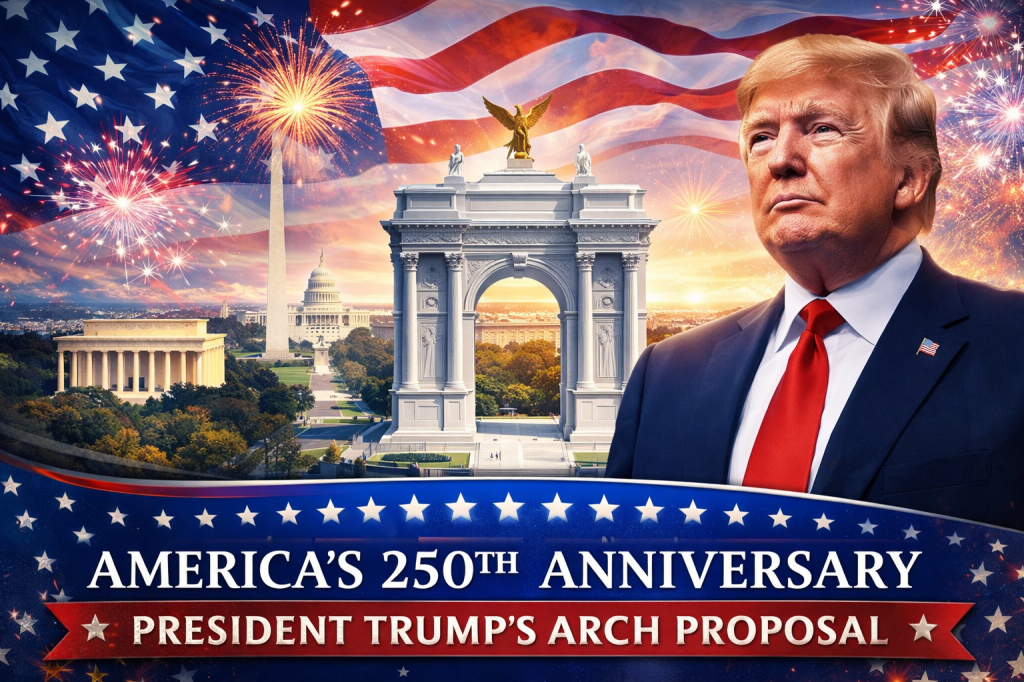
As the United States approaches its 250th anniversary in 2026, Donald Trump has floated an idea that is already sparking debate in Washington: the construction of a monumental arch in Washington, D.C. to mark the nation’s semiquincentennial.
The proposal, reported by NBC Washington, has been greeted by critics with predictable sarcasm—some focusing on Trump’s rhetoric, others dismissing the idea as unnecessary or grandiose. But stripped of partisan reflexes, the concept itself raises a serious and worthwhile question: how should the nation commemorate 250 years of American independence?
Monumental Thinking Is an American Tradition
Washington is a city defined by symbolism. The Washington Monument, Lincoln Memorial, Jefferson Memorial, and Capitol dome were all controversial in their time—criticized for cost, scale, or ambition. Today, they are inseparable from America’s civic identity.
An arch would hardly be out of place in that tradition. Cities across the world use monumental architecture to tell their national story. Paris has the Arc de Triomphe. St. Louis has the Gateway Arch. These structures are not distractions; they are declarations—visible reminders of national purpose and historical continuity.
A carefully designed arch in Washington, integrated thoughtfully into the city’s existing monumental landscape, could serve as a unifying symbol rather than a competing one.
Why the 250th Matters
America’s 250th birthday is not just a ceremonial milestone. It is a once-in-a-generation opportunity to reflect on endurance, self-government, and the constitutional experiment that has outlasted empires and ideologies.
At a time of polarization and institutional distrust, national symbols still matter. They reinforce shared history in a way legislation and speeches cannot. A monument does not resolve political disagreements—but it can remind Americans that those disagreements occur within a common constitutional framework.
From a center-right perspective, this is about national confidence, not personality politics. Nations that believe in themselves commemorate their history boldly. They do not outsource civic pride or shy away from permanence.
The Debate We Should Actually Have
The real discussion should not revolve around who proposed the idea, but how such a project would be executed—if at all.
Legitimate questions remain:
- Where would an arch be located?
- How would it be funded?
- Who would design it?
- How would it respect existing memorials and public space?
Those questions deserve rigorous scrutiny, congressional oversight, and public input. But dismissing the idea outright because it is ambitious—or because it comes from Trump—reflects small thinking at a moment that arguably calls for the opposite.
A Moment Worth Marking
America turns 250 only once. Whether President Trump’s arch proposal ultimately moves forward or not, it challenges Washington to think beyond temporary gestures and commemorative press releases.
The question is not whether every American will agree on the design. It’s whether the country is still willing to think in monuments—structures meant to outlast administrations, parties, and political moods.
That conversation, at least, is long overdue.
 Federal City News