By FCN Staff
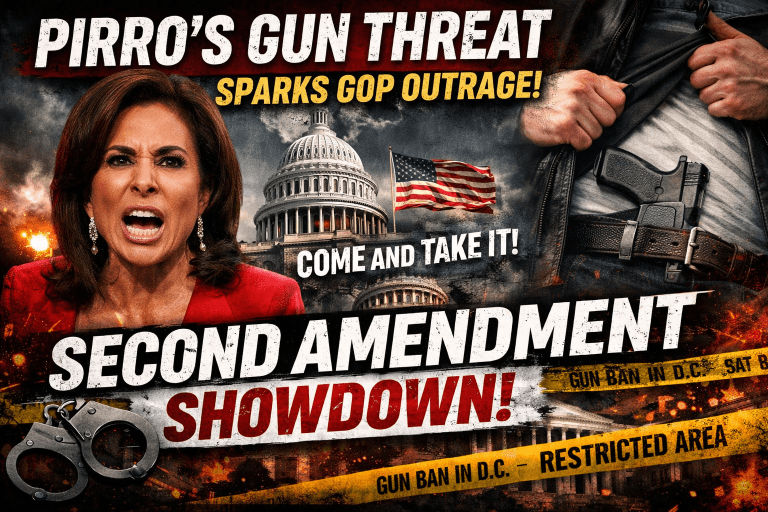
In a development that has stunned many on the center-right, U.S. Attorney Jeanine Pirro — the top federal prosecutor in the District of Columbia and a well-known Republican loyalist — ignited a firestorm this week by bluntly warning that anyone who brings a firearm into the nation’s capital “is going to jail.”
Pirro made the comments during a televised interview, saying that even law-abiding gun owners licensed in other jurisdictions should expect arrest if they enter Washington with a weapon. Her language — particularly the line “I don’t care if you have a license in another district and I don’t care if you’re a law-abiding gun owner somewhere else” — struck many conservatives as extraordinarily heavy-handed and legally questionable.
Within hours, prominent Republican lawmakers and gun-rights organizations condemned Pirro’s remarks as an affront to the Second Amendment and a stark departure from long-standing GOP principles. Representative Thomas Massie of Kentucky publicly rebuked Pirro’s stance, pointing out that D.C. operates under a “shall issue” concealed carry regime and that non-residents can obtain permits — a point that contradicts the notion that every gun carried into the District should automatically lead to imprisonment.
Florida Representative Greg Steube went further, declaring that he routinely brings a firearm into D.C. and defiantly asserting “Come and take it!” — language emblematic of the pro-gun rights movement’s determination not to see constitutional liberties curtailed by local enforcement decisions.
The backlash was bipartisan in tone, with critics not only within the GOP but across the broader Second Amendment community expressing concern about both the substance and optics of Pirro’s statements. The National Rifle Association seized the moment to call for nationwide concealed carry reciprocity — legislation long championed by conservatives — as a necessary defense against localized restrictions that, in practice, limit the exercise of the right to bear arms.
Faced with the uproar, Pirro took to social media to clarify her position, emphasizing that she is a “proud supporter of the Second Amendment” and framing her comments as focused on unlawful gun possession, not the rights of responsible owners. Deputy Attorney General Todd Blanche echoed those sentiments, asserting that the Department of Justice “will fiercely protect Second Amendment rights,” even as the initial remarks raised alarms within traditional conservative circles.
This episode underscores a broader tension within the Republican coalition over how to balance public safety with constitutional liberties — particularly in the wake of high-profile law-enforcement incidents and disputes over federal jurisdiction in local policy. For many gun-rights advocates, Pirro’s comments — regardless of the subsequent clarification — represent an unwelcome expansion of prosecutorial discretion into what they view as fundamental constitutional territory.
Ultimately, the controversy may prove to be more than a media flashpoint: it could catalyze renewed calls among GOP lawmakers to codify stronger protections for interstate firearm rights ahead of the 2026 midterms, while also forcing the Trump administration and its allies to more carefully calibrate rhetoric around gun enforcement. Whether this tension leads to policy action or simply political sparring, the episode has exposed fissures in conservative orthodoxy that are unlikely to dissipate soon.
 Federal City News